Football Positions Explained: Roles, Shirt Numbers and Modern Responsibilities
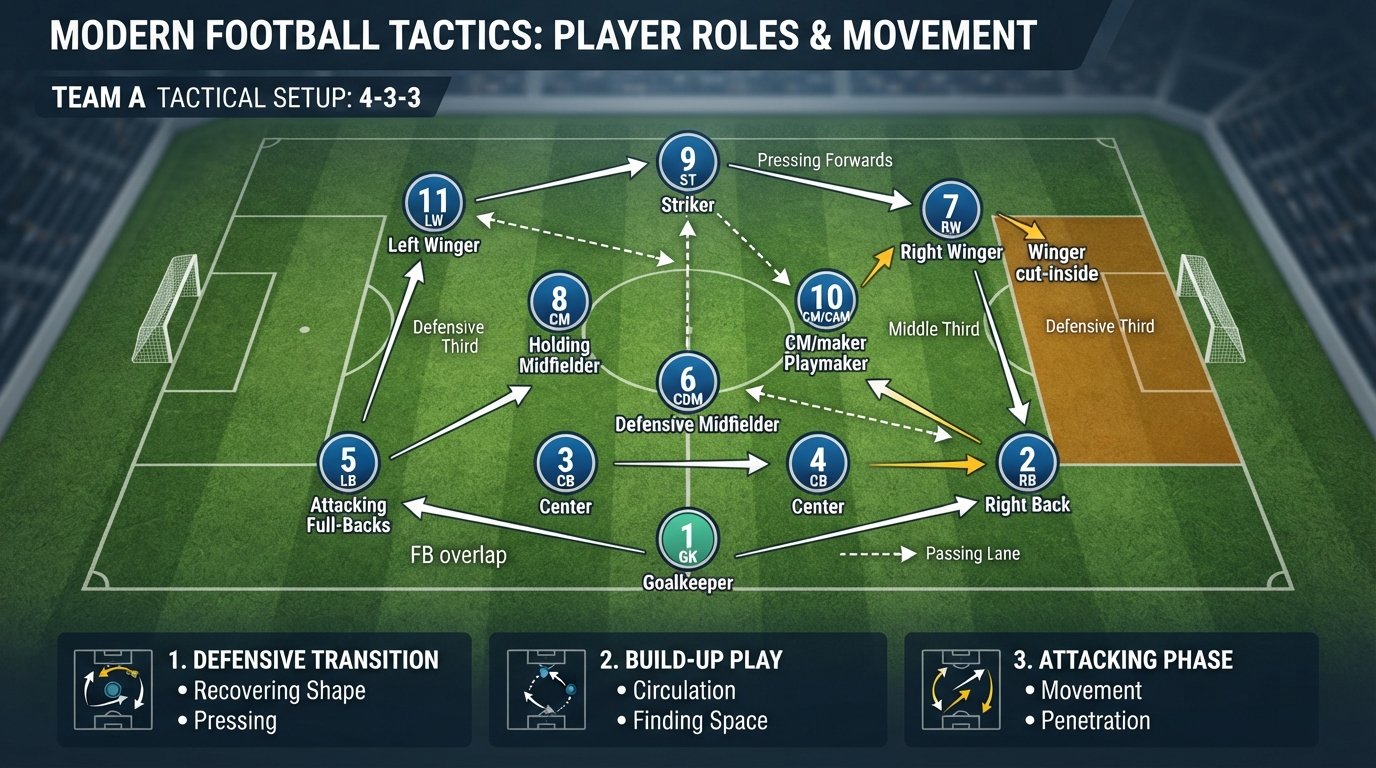
Football positions are best understood as responsibilities rather than fixed spots on a team sheet. A “right-back” may defend the flank in one phase, move into midfield in another and sprint beyond the winger in the next. A centre-forward can finish moves, press a centre-back, create space for a runner or drop into midfield.
The label provides a starting point; the team’s game model gives it meaning.
This guide combines the traditional shirt-number vocabulary with the decisions players must make in contemporary football. It also separates rules from convention. The
Position is a job description, not a dot on the pitch
Every position has demands in four connected areas: technical execution, tactical understanding, physical output and decision-making. A defender needs to control distance to teammates as well as tackle. A midfielder must scan before receiving, choose when to turn and protect the centre after losing the ball.
An attacker needs to threaten depth even when not receiving a pass. Good positional play makes the next action easier for someone else.
Coaches often describe a role through the team’s four moments: possession, defending, attacking transition and defensive transition. In possession, a player may provide width, depth or a passing angle. When defending, the same player may narrow the space, screen a pass or cover a teammate.
Immediately after a turnover, the priority can change from supporting the attack to delaying a counterattack. This is why judging a player only by where they started misses much of the work.
Shirt numbers: a helpful map with flexible borders
Traditional numbers developed from old formations and became associated with familiar duties. Number 1 usually means goalkeeper, 2 and 3 commonly suggest full-backs, 4 and 5 centre-backs, 6 a holding midfielder, 8 a two-way midfielder, 10 a creative midfielder, 7 and 11 wide attackers, and 9 a central forward. Clubs and countries vary, and modern squad numbering means a player’s shirt can be inherited, marketed or simply preferred.
| Shirt-number shorthand | Traditional role | Modern responsibility |
|---|---|---|
| 1 | Goalkeeper | Save, organise, restart play and offer an extra passing option. |
| 2 or 3 | Full-back | Defend wide areas, create width, overlap or move inside to support build-up. |
| 4 or 5 | Centre-back | Protect the penalty area, win duels, cover space and progress possession. |
| 6 | Holding midfielder | Screen the defence, set the rhythm and secure the team after attacks. |
| 8 | Central or box-to-box midfielder | Connect phases, arrive in the box and press or cover large spaces. |
| 10 | Attacking midfielder | Receive between lines, combine around the box and create final passes. |
| 7, 11 or 9 | Winger or centre-forward | Stretch the defence, attack depth, finish and lead the press. |
Goalkeeper and defenders: building security from the back
The goalkeeper’s first responsibility remains preventing goals, but the modern goalkeeper also manages the space behind the defensive line. A high starting position can clear through balls before they become chances. With the ball, the goalkeeper must judge whether to play short, switch the point of attack or go long beyond pressure.
Communication matters because defenders often see the play facing their own goal.
Centre-backs defend the goal, but they also decide when to step forward. The near centre-back can engage a striker while the partner covers behind. On the ball, a centre-back may carry forward to draw out a midfielder or play a firm pass into the next line.
The key is risk management: progression is valuable only when the team has enough cover if possession is lost.
Full-backs have one of the game’s widest briefs. They must defend one-versus-one situations, track runners, support the winger and deliver crosses or cut-backs. An overlapping full-back runs outside a teammate; an inverted full-back moves toward the centre to help circulate the ball and protect against a counterattack.
UEFA’s technical observers documented how elite teams can change their shape in possession, including full-backs moving inside and centre-backs stepping into midfield. Read the Midfielders: controlling space, time and connections The number 6 operates behind the ball more often than the number 8. Their duties include offering a safe outlet, receiving on the half-turn, covering the centre-backs and stopping direct counterattacks. A single pivot must scan constantly because a poor body position can expose the entire middle. In a double pivot, one midfielder may support the ball while the other holds a protective position. The number 8 links defence and attack. They support the first pass, press an opponent’s pivot, cover a full-back and make late runs into the penalty area. “Box-to-box” should not mean running without purpose. The best number 8 recognises when to accelerate, when to stay connected and when to occupy a passing lane that creates room for a teammate. The number 10 works between the opponent’s midfield and defence, a zone often called the space between the lines. They may receive with pressure behind, combine with a forward, switch play or make a decoy run. The role is less about attempting spectacular passes than about manipulating defenders. Dropping toward the ball can draw a centre-back out; staying high can pin that defender and open a lane for an advancing midfielder. These distinctions are supported by modern coaching research. In its position-specific guidance, the Wingers and forwards: creating and finishing danger A winger may provide touchline width, cut inside onto a stronger foot or run behind a full-back. Their defensive brief can include pressing the opposing full-back, tracking an overlapping runner and protecting the team’s inside channel. When a winger moves inward, someone else must usually provide width. That may be a full-back, a midfielder or a temporarily rotating forward. The centre-forward is often judged by goals, yet the role begins before the shot. A forward can pin centre-backs, threaten the space behind them, set the ball for a midfielder, attack the near post or press the goalkeeper’s passing lane. A striker who creates a gap for a teammate may perform an important attacking action without touching the final pass.