Football Loan Deals Explained: Options, Obligations, Buy-Backs and Recall Clauses
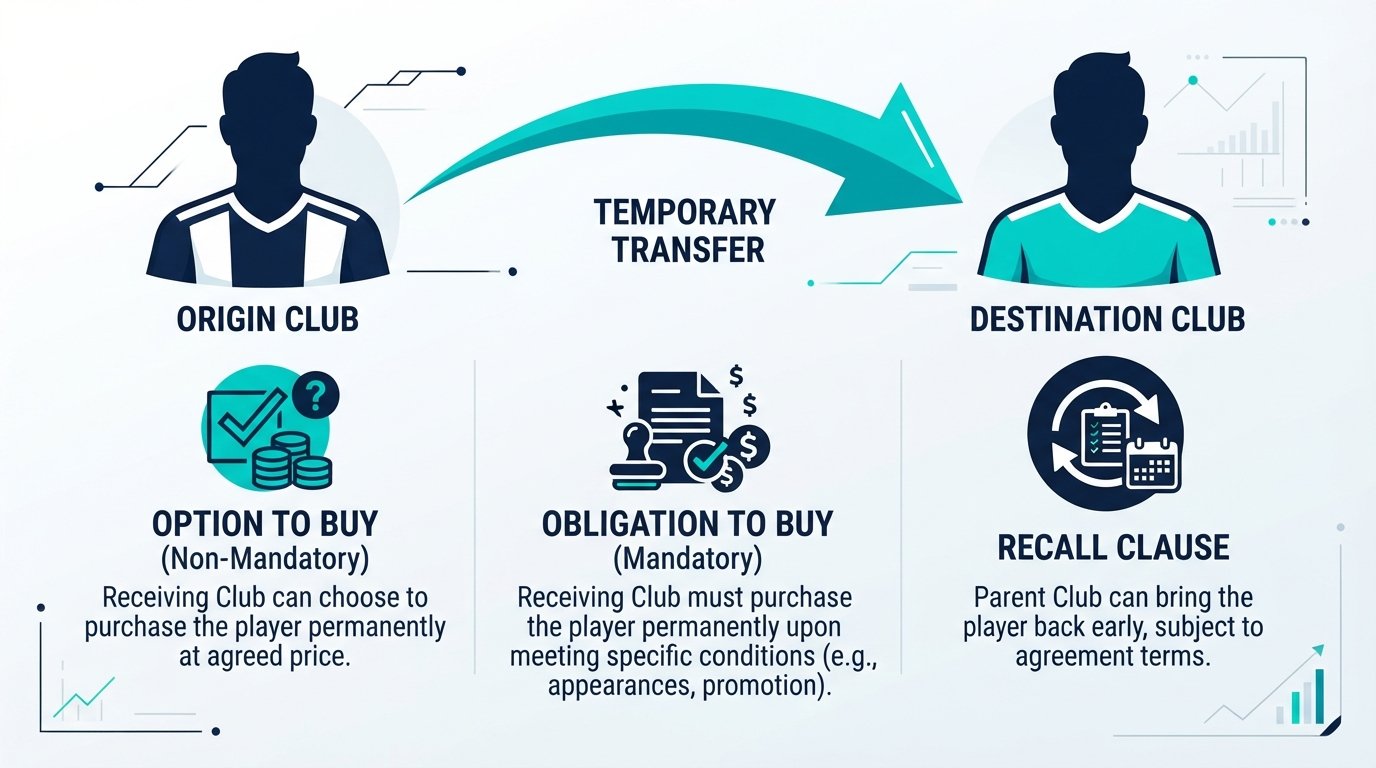
A football loan is a temporary change of registration, not a disguised permanent transfer. The player joins a new club for an agreed period, while the original club usually retains the long-term contract and the economic upside of a future sale. That simple description hides several decisions: who pays the salary, whether a transfer fee is charged, whether the borrower can buy the player, and whether the original club can bring him back early.
Understanding those details is essential for supporters, players and anyone assessing a transfer story.
What a loan actually changes
During a normal loan, the borrowing club gains the right to register and select the player for the agreed competition period. The parent club, sometimes called the former club or lender, keeps the player’s permanent registration rights. The player is not sold, and the loan does not automatically extend or replace his career contract.
FIFA’s rules say that the player’s contractual obligations with the former club are suspended during the loan unless the parties agree otherwise in writing. In practical terms, the temporary club normally becomes responsible for the day-to-day employment relationship, while the original club remains involved in the underlying permanent contract. A properly signed document should therefore state the term, financial conditions and each club’s responsibilities rather than relying on a press release or verbal promise.
Registration is a separate practical issue. A player may be unable to appear until the relevant association approves the paperwork, even if both clubs have announced an agreement. For example, The Football Association explains that a loan requires the relevant registration form, supporting documents and compliance with the applicable league handbook.
It also says that signed registration documents must be submitted within the stated deadline. Fans should distinguish “loan agreed” from “player eligible to play.”
The financial menu: fee, wages and bonuses
A loan can be free, or it can include a temporary loan fee. The borrower may pay all of the player’s salary, share it with the parent club, or agree to reimburse only certain costs. Appearance bonuses, promotion bonuses and performance incentives can be added on top.
None of these arrangements changes the basic fact that the player’s registration returns when the temporary term ends unless another transfer is completed.
| Term in a loan deal | What it normally means | Question to ask |
|---|---|---|
| Loan fee | Payment for the temporary registration, separate from wages | Is it fixed, conditional or instalment-based? |
| Wage contribution | The share of salary paid by each club | Who pays during injury or suspension? |
| Option to buy | The borrower may make the move permanent at a stated price | What is the deadline and how is notice given? |
| Obligation to buy | A permanent transfer must occur when defined conditions are met | Is the trigger appearances, promotion, or something else? |
| Recall clause | A contractual route for the parent club to end the loan early | When can it be used, and is consent required? |
Consider a practical example. Club North loans midfielder Elena to Club South for one season, charges a £500,000 loan fee and pays 40 per cent of her wages. The agreement awards North an additional £100,000 if Elena makes 20 league appearances.
That bonus is a condition of the temporary deal, not a permanent transfer fee. If South later pays an agreed purchase price under an option, that is a new transaction with its own registration and contract paperwork.
Option to buy versus obligation to buy
An option to buy gives the borrowing club a choice. If the player fits the system, stays healthy and performs well, the borrower can usually activate the permanent transfer at the negotiated price. If the player does not meet expectations, the borrower can allow the loan to expire, subject to the precise deadline and notice requirements.
An obligation to buy is different. It turns the temporary move into a commitment when a stated trigger occurs. The trigger might be a number of starts, a club’s promotion, qualification for a competition, or the player remaining available through a particular date.
A hypothetical clause could require South to buy Elena for £12 million after her 25th competitive appearance. The parties should define whether substitute appearances count, what happens after an injury, and when payment and registration take place.
Reporters sometimes call every purchase clause a “mandatory option,” but the wording matters. An option is discretionary until exercised. An obligation is conditional only until its trigger is met.
A reader assessing a transfer should look for the actual clause, not infer its legal effect from a headline.
Buy-backs: a different kind of protection
A buy-back clause normally appears in a permanent transfer, not in an ordinary loan. It allows the former club to repurchase the player later at a defined price or under a defined formula. It can also give the former club a matching right if another club makes an offer.
A buy-back is therefore a future acquisition right retained after ownership has changed; a recall is an early return mechanism while the player remains on loan.
For example, Club East permanently sells a young defender to Club West for £8 million but negotiates a right to buy him back for £14 million during the next two summer windows. East no longer has a loan recall right because the temporary arrangement has ended. If East instead loans the defender to West for a season with a right to recall in January, East retains the original contract relationship and is using a recall clause, not a buy-back clause.
How recall clauses work
A recall clause should identify who can activate it, the permitted dates, the notice method and the player’s registration destination. It may be unconditional, or it may apply only if a goalkeeper is injured, the parent club loses another player, or the borrower fails to meet a sporting or financial condition. Some competitions restrict mid-season registrations, so a theoretically valid recall may still require an open window or association approval.
Imagine Club North loans goalkeeper Marco to Club South until 31 May. North negotiates a January recall only if its first-choice goalkeeper is unavailable for at least six weeks. When that injury occurs, North must follow the written notice procedure and any league registration process.
South cannot assume that an email from North’s sporting director is enough. The agreement and the competition rules control the outcome.
Recall clauses can protect the parent club, but they reduce certainty for the borrower. South may invest in coaching, housing and a tactical plan while knowing Marco could leave. A borrower seeking stability might accept a recall only during a specified window, or demand a replacement-payment mechanism.
The player should also understand whether a recall changes his wage, selection prospects and medical support.
Obligations beyond the headline clause
A careful loan agreement covers more than the purchase price. It can address medical examinations, insurance, rehabilitation, training access, facilities, travel, discipline, image rights, international call-ups and data sharing. Clubs often negotiate whether the player can face the parent club, whether the borrower must use him for a minimum number of matches, and who bears costs if the player is injured while representing his country.
Competition rules may also limit what the contract can achieve. FIFA’s published loan framework identifies a written agreement, a defined duration and limits on sub-loaning, while UEFA’s club-licensing rules require clubs to respect FIFA loan regulations. FIFA also states that a professional on loan cannot be sub-loaned or permanently transferred by the new club to a third club.
Domestic leagues may impose additional squad, registration or eligibility rules, so legal review is not optional for a high-value deal.
A practical checklist for reading any loan announcement
- Identify the term. Check the start date, end date and any permitted extension.
- Separate the payments. Look for the loan fee, wage split and performance bonuses.
- Classify the purchase language. Decide whether it is an option, an obligation or no purchase route at all.
- Test the trigger. Ask what counts as an appearance, promotion, qualification or injury event.
- Check recall rights. Find the activation window, notice requirement and registration conditions.
- Confirm eligibility. An announced deal is not the same as an approved registration.
Why the wording matters
The safest conclusion is that no two loan deals are identical. A one-year developmental loan with no recall is not equivalent to a six-month move with a conditional purchase obligation. The public fee may omit salary reimbursement, bonuses or sell-on protections.
Likewise, “the club has an option” says little without the price, expiry date and exercise procedure.
For trustworthy transfer analysis, start with the governing document and then check the relevant association’s rules. FIFA’s regulations provide the international baseline, The FA’s registration guidance illustrates how domestic administration works, and UEFA’s licensing rules show why regulatory compliance remains a club responsibility. Those sources do not replace advice from a qualified football lawyer, but they provide a reliable framework for separating a temporary opportunity from a binding future commitment.
Sources and editorial note
This explainer uses the international loan-regulation framework, UEFA’s 2026 club-licensing provision on loans. Rules can change by association and competition; the signed agreement and the applicable league handbook should always be checked before relying on a clause.

My name is Jeferson, a passionate football enthusiast and the creator of this portal dedicated to fans of the world’s most popular sport. My goal is to provide reliable information, up-to-date news, match analysis, transfer updates, tournament coverage, and everything happening both on and off the pitch.