Football Formations Explained: 4-3-3, 4-2-3-1, 3-5-2 and When Teams Use Them
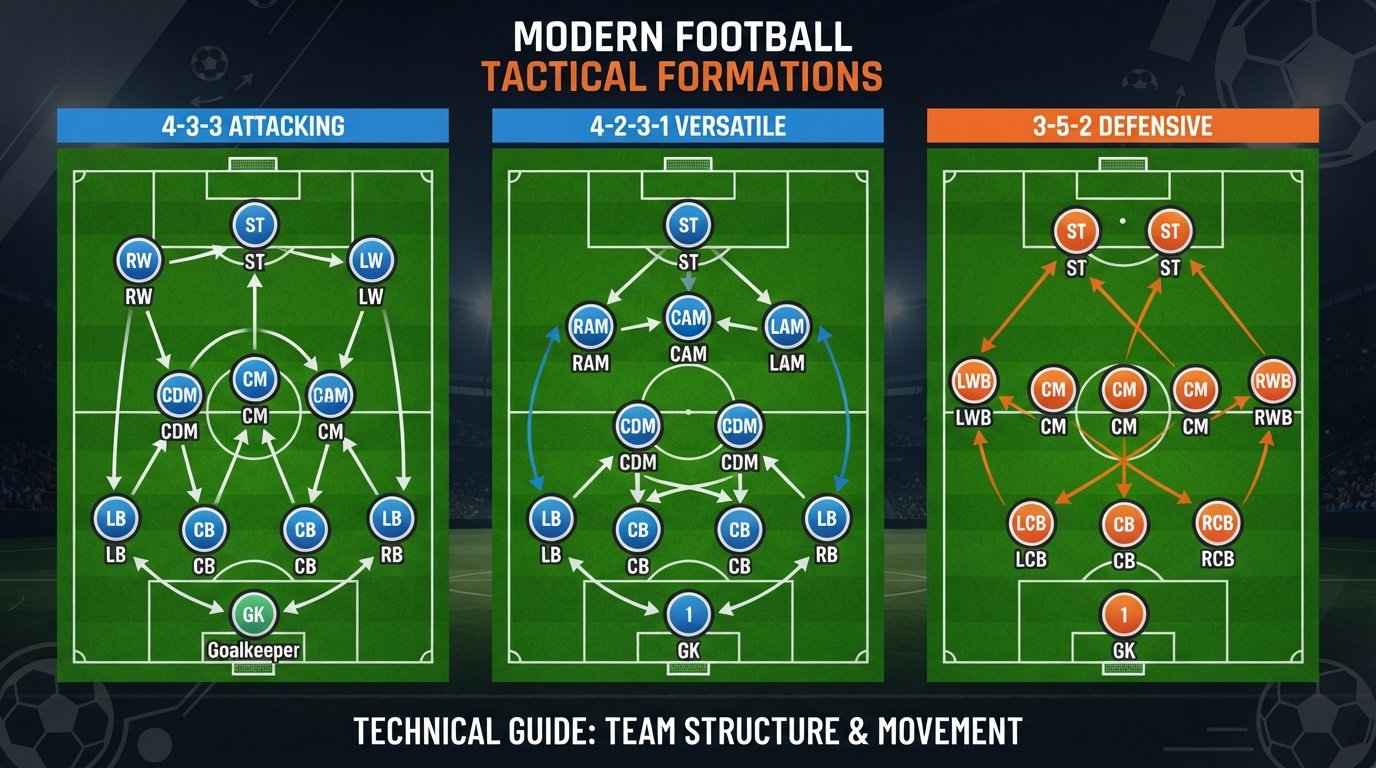
Football formations are the starting map for a team, not a set of rails that players must never leave. The first number describes defenders, the second midfielders, and the final number forwards. Thus, a 4-3-3 normally has four defenders, three midfielders and three attackers.
A 4-2-3-1 has four defenders, two deeper midfielders, three advanced players and one centre-forward. A 3-5-2 has three centre-backs, five midfielders and two forwards. The goalkeeper is not included in the notation.
That shorthand is useful because it shows where a team intends to create numbers, width and defensive cover. It does not describe every moment of a match. Players rotate, full-backs advance, wingers move inside and midfielders cover for one another.
How to read a formation before judging it
Begin with three questions. Where does the team want its first passing advantage? Who supplies width? What happens immediately after possession is lost? The answers reveal more than the numbers alone.
For example, a 4-3-3 may become a 3-2-5 in possession when one full-back moves into midfield and the other stays deeper. The same team may defend in a compact 4-1-4-1, with the wingers dropping alongside the two number eights. A 3-5-2 can attack with wing-backs high and defend as a 5-3-2.
These are not contradictory labels. They are descriptions of different phases.
It is also worth remembering that the Laws of the Game do not prescribe a tactical formation. 4-3-3: width, pressing and a spare midfielder The 4-3-3 places one holding midfielder behind two more advanced central midfielders, with two wingers beside a lone striker. Its central benefit is the extra midfielder against an opponent using a midfield two. The three midfielders can form passing triangles, offer different heights and help the team play through pressure. The wingers also pin opposing full-backs or centre-backs, which can open a lane for an advancing full-back or an underlapping midfielder. Coaches often choose 4-3-3 when they want to control possession, press with three players in the first line or attack the full width of the pitch. The centre-forward can screen a centre-back while the wingers close passing lanes to the full-backs. Behind them, the midfield three can step forward in waves rather than leaving one player responsible for every central action. The cost is workload and exposure. The lone striker can be isolated against three centre-backs. If both full-backs advance and the ball is lost, the holding midfielder may have to protect a very large area. A quick switch can also isolate a full-back because the winger is still high. The system works best when the holding midfielder reads danger, the midfielders cover laterally and the front three react quickly after turnovers. Practical example: Imagine a 4-3-3 building against a 5-3-2. Passing directly to a full-back in the team’s own half may invite the opponent’s wing-back and forward to trap that player near the touchline. A better sequence is for the centre-backs to create different passing angles, the midfielders to start high and then come short, and the goalkeeper to recycle the ball if the central lane closes. FIFA Training Centre’s 4-2-3-1: the balanced double pivot The 4-2-3-1 uses two holding or central midfielders in front of the back four, a number 10 between the lines, two wide attackers and one striker. The double pivot gives the centre-backs two nearby passing options and can protect the space in front of them. One midfielder may hold while the other advances, or both can shift across to cover a full-back. This formation is popular because it offers a clear connection between defence and attack. The number 10 can receive behind an opponent’s midfield, drop beside the pivots during build-up or join the striker to form a front two. The wide players can hold the touchline, cut inside or track opposing full-backs. The full-backs therefore have permission to advance when the pivots provide cover. Its central weakness is that the double pivot can become passive. If the number 10 does not drop when the team is defending, the two deeper midfielders may face three opponents. The front striker can also become lonely if the attacking midfielders stay too far away. Wide spaces may be exposed when both full-backs advance and the pivots cannot shift across in time. Practical example: A side that is chasing a goal can ask the number 10 to move close to the striker, turning the attack into a temporary 4-4-2 or 4-2-2-2. The full-backs then provide width while the two pivots guard against the counter. When protecting a narrow lead, the same team can keep the number 10 deeper and defend in a 4-4-1-1. This ability to change jobs without making several substitutions explains why 4-2-3-1 is often selected for matches in which the score and opponent may demand different responses. The 3-5-2 has three centre-backs, a midfield line usually containing a holding player and two central midfielders, two wing-backs and two forwards. It gives the team two strikers against a back four and three defenders against two forwards. The wing-backs supply the width that would normally come from wingers, while the central midfielders can create a numerical advantage in the middle. Teams choose 3-5-2 when they want two forwards to occupy opposing centre-backs, an extra defender to start attacks and a strong presence between the penalty areas. The outside centre-backs can step into midfield with the ball, and the two forwards can alternate between running behind, combining and pinning the defensive line. In the defensive phase, the wing-backs retreat to make a back five, giving the team a 5-3-2 block. The trade-off is demanding wing-back work. If both wing-backs are caught high, the team can be vulnerable in the channels beside the outside centre-backs. If they drop too early, the attack may lose width and become crowded centrally. The system also depends on the three centre-backs communicating clearly when one steps out to meet a winger or a dropping striker. Practical example: Against a 4-3-3, a 3-5-2 can ask each wing-back to pin an opposing full-back while the two forwards occupy the centre-backs. If the opponent’s winger tracks back, the wing-back may combine with an outside centre-back and a central midfielder to create a three-versus-two on the flank. If the ball is lost, the first priority is not an immediate forward sprint; it is recovering the wing-backs’ positions so the back line becomes a stable five. Elite teams regularly change their structure without changing all eleven players. In its Choosing between the three systems There is no universally superior formation. A team with aggressive wingers, a reliable holding midfielder and athletic full-backs may get the most from 4-3-3. A squad with a creative number 10 and two disciplined central midfielders may prefer 4-2-3-1. A team with mobile forwards, three confident centre-backs and exceptional wing-backs may make 3-5-2 a strength rather than a compromise. Coaches should match the system to player qualities, opponent threats and the physical demands of the plan. They should also define the team’s rest-defence structure: how many players remain behind the ball when an attack develops. A formation that looks adventurous is still controlled if the team can close central counters and recover wide positions. Conversely, a cautious diagram can be vulnerable if players are stretched and disconnected. For supporters, the most useful checklist is to track relationships rather than labels. Watch who creates the first passing angle, who covers the full-back, which player receives between the lines and how quickly the team forms its defensive block. Formations explain the intended organisation; movement, spacing and decision-making explain whether that organisation works. UEFA, Champions League technical report: How 4-3-3 overtook 4-2-3-1. Coaches’ Voice, Formations: football tactics explained. My name is Jeferson, a passionate football enthusiast and the creator of this portal dedicated to fans of the world’s most popular sport. My goal is to provide reliable information, up-to-date news, match analysis, transfer updates, tournament coverage, and everything happening both on and off the pitch.3-5-2: central numbers and wing-back responsibility
What real matches teach us about formation changes
References