How Football Transfer Fees Have Changed Over the Years
|
Getting your Trinity Audio player ready... |
Remember when the world’s most expensive footballer cost just £100? Welcome to 1905, when Alf Common became the first player to break the £1,000 barrier. Fast forward to 2017, and Neymar’s €222 million transfer from Barcelona to Paris Saint-Germain shattered every expectation. This isn’t just inflation—it’s a complete transformation of football into a billion-dollar global business.
Over the past 120 years, football transfer fees have skyrocketed from £100 to staggering amounts exceeding €100 million for single players. Of the 30 most expensive transfers in football history, 29 occurred in the past decade alone. Manchester City splashed €1.5 billion on 69 players over ten years, while English clubs dominated global spending with $7.23 billion in net transfer expenditure.
But what drove this explosive growth? Broadcasting deals, merchandise revenue, TV rights, and the globalization of football created a financial tsunami that reshaped player valuations forever. Today, €100 million transfers are commonplace, and the question isn’t whether a club can afford Neymar—it’s whether any player is worth that price.
Whether you’re a casual fan curious about why Kylian Mbappé commands such wages or a seasoned supporter wondering if football inflation is unsustainable, this guide delivers comprehensive insights into the evolution of transfer fees. Let’s dive into the fascinating history that transformed “the people’s game” into corporate giants competing for sporting superstars.
The Early Years: When Transfer Fees Were Almost Nothing
The First Recorded Transfer Fees (1905-1950)
Football’s transfer system began in modest fashion. In 1905, Alf Common’s move to Middlesbrough marked history as the first transfer exceeding £1,000—a shocking amount for working-class families at that time. Before this, players typically changed clubs for mere hundreds of pounds, sometimes even just £100.
The timeline tells the story vividly:
- 1905: Alf Common becomes first £1,000+ player (£1,000)
- 1920s: Maximum transfer fees rarely exceeded £5,000
- 1930s: Star players like Stan Cullis transferred for under £10,000
- 1948: Danny Blanchflower’s transfer reached £12,000
These figures seem absurdly low compared to modern standards, but they reflected football’s position as a local sport with limited revenue streams. Clubs relied primarily on matchday ticket sales, with minimal broadcasting or commercial income.
Post-War Era and the First Major Breakthroughs (1950-1970)
The post-war period ignited the first significant transfer fee increases. In 1954, Dick Kiernan became the first player to cost £25,000 when he moved to Preston North End. By 1961, Jimmy Greaves shattered barriers with a £99,999 transfer to Tottenham Hotspur—just £1 under the £100,000 mark to avoid psychological resistance.
The breakthrough arrived in 1963 when Peter Southam transferred for £100,000, officially breaking the six-figure barrier. This milestone represented football’s gradual transition from local entertainment to professional business.
Key factors driving early growth included:
- Increased television coverage of major matches
- Growing stadium attendance in the 1950s-60s
- Rising club revenues from merchandise sales
- Professionalization of player contracts
Despite these changes, transfer fees remained relatively restrained. Even legendary players like Bobby Charlton and Denis Law transferred for amounts under £250,000 through the 1960s.
The Revolution Begins: 1970s-1990s
The Booster of Broadcasting Money (1970-1985)
The 1970s marked football’s first major financial revolution. Sky Television and emerging broadcast networks began paying serious money for football rights, injecting new revenue into club finances.
In 1974, Denis Law’s transfer to Manchester City reached £300,000. By 1979, Gary Lineker‘s move to Barcelona cost £1.2 million—a fourfold increase in just five years.
The broadcasting revolution accelerated dramatically:
- 1983: ITV secured Premier League rights for £6 million annually
- 1986: First major satellite broadcasting deals signed
- 1988: Transfer fees routinely exceeded £2 million
The Premier League Effect (1990-1995)
The formation of the English Premier League in 1992 transformed football economics forever. The new league negotiated its own broadcasting deals, separating from the old Football League structure.
In 1990, Premier League transfer fees increased 40-fold since 1990 according to The Times report, with TV rights, merchandise, and matchday revenue contributing massively.
The most iconic transfer of this era: 1990 saw Gary Lineker transfer to Barcelona for £1.2 million, but by 1995, Alan Shearer‘s move to Newcastle reached £15 million—a 12.5x increase in just five years.
Key milestones from this period:
| Year | Player | Transfer Fee | Clubs |
|---|---|---|---|
| 1990 | Gary Lineker | £1.2 million | Tottenham → Barcelona |
| 1992 | Ruud Gullit | £5 million | PSV → AC Milan |
| 1995 | Alan Shearer | £15 million | Blackburn → Newcastle |
| 1998 | Christian Karembeu | £12 million | Nantes → Real Madrid |
The Premier League’s £3 billion three-year Sky/BT deal in 2012 equated to an extra £14 million per year for each of the 20 clubs. This broadcasting money directly fueled transfer fee inflation.
The European Expansion (1995-2000)
As the European Union expanded, player mobility increased dramatically. The Bosman Rule of 1995 allowed players to move freely between EU countries at the end of contracts, fundamentally changing transfer economics.
This ruling:
- Eliminated transfer fees for out-of-contract EU players
- Increased competition for top talent
- Forced clubs to pay higher wages to retain players
- Created a more global transfer market
Post-Bosman, transfer fees for in-contract players surged as clubs demanded compensation for losingplayers without transfer fees. Zinedine Zidane’s 2001 transfer to Real Madrid for €75 million set a new standard.
The Modern Era: 2000s-2010s
The Messi-Ronaldo Era and Fee Explosion (2000-2010)
The 2000s witnessed football’s transformation into a global phenomenon. Broadcasting deals reached record levels, with BT Sport securing £897 million for UEFA Champions League rights in 2013.
Iconic transfers from this period:
- 2000: Luis Enrique to Barcelona for €60 million
- 2001: Zidane to Real Madrid for €75 million
- 2004: Hernán Crespo to Chelsea for €36 million
- 2009: Cristiano Ronaldo to Real Madrid for €94 million
- 2009: Kaka to Real Madrid for €67 million
The 2009/10 season marked a turning point. Transfer prices increased 12.1% compared to 2009/10, meaning a €10 million player in 2009 would cost €11.2 million today.
The Neymar revolution (2010-2017)
The 2010s saw transfer fees enter unprecedented territory. Manchester City became the biggest spender over the decade, purchasing 69 players for €1.5 billion.
Critical milestones:
- 2013: Neymar to Barcelona for €57 million
- 2016: Paul Pogba to Manchester United for €105 million
- 2017: Neymar to PSG for €222 million ⚡
Neymar’s €222 million transfer remains the all-time top transfer fee and represents the single most dramatic fee explosion in football history. This transfer alone exceeded the combined cost of the top 10 transfers from the 1990s.
The €100 Million Club (2017-2020)
Post-Neymar, €100 million transfers became commonplace. The market normalized at levels that seemed impossible a decade earlier.
Top transfers from 2017-2020:
- Kylian Mbappé (2018): Monaco → PSG, €180 million
- João Félix (2019): Benfica → Atlético Madrid, €127 million
- Antoine Griezmann (2019): Atlético Madrid → Barcelona, €120 million
- Harry Maguire (2019): Leicester → Manchester United, €87 million
- Bruno Fernandes (2020): Sporting → Manchester United, €55 million
Of the 30 most expensive transfers in football history, 29 occurred in the past decade. This statistic alone demonstrates the unprecedented acceleration of transfer fee growth.
The Current Landscape: 2020s and Beyond
Record-Breaking Transfers Continue (2020-2026)
The 2020s maintained the €100 million+ standard. Recent exceptional transfers include:
- 2022: Enzo Fernández to Chelsea for €121 million
- 2023: Declan Rice to Arsenal for €116 million
- 2024: Jadon Sancho’s potential €100+ million moves
- 2025: Florian Wirtz to Liverpool for €125 million
Liverpool’s €125 million payment for Florian Wirtz represents the latest benchmark, showing that even young players command astronomical fees.
Global Spending Patterns
According to FIFA research, more than £38 billion ($48.5 billion) was spent on transfer fees worldwide over the past decade. English clubs dominated this spending:
| Nation | Net Transfer Spend (2010-2020) |
|---|---|
| England | $7.23 billion (£5.26 billion) |
| China | $1.46 billion (£1.06 billion) |
| Spain | $1.12 billion |
| Germany | $0.98 billion |
| Italy | $0.87 billion |
English clubs’ spending was far higher than any other nation, with 12 Premier League clubs in the top 30 biggest spenders globally.
Key Drivers of Modern Fee Growth
Several factors continue driving transfer fee inflation:
1. Broadcasting Revenue Explosion
- Premier League 2022-25 deal: £10 billion over three years
- UEFA Champions League broadcasting: €2+ billion annually
- Global streaming rights reaching new markets
2. Commercial Revenue Growth
- Merchandise sales doubling in major leagues
- Sponsorship deals exceeding €100 million annually
- Global fanbase expansion into Asia and Americas
3. Wage Pressure
- Top players earning €400,000+ weekly
- Clubs using transfer fees to offset wage inflation
- Competition for limited elite talent
4. Financial Fair Play Loopholes
- Clubs using transfer fees for asset appreciation
- Selling clubs profiting from player development
- Investment funds entering football ownership
Understanding Football Inflation: Are Fees Really That High?
The Inflation Debate
Would Diego Maradona really be worth the same as Andre Gray in today’s market? This question highlights the “football inflation” debate.
Critics argue transfer fees have inflated beyond sustainable levels:
- 40-fold increase in Premier League fees since 1990
- €222 million for Neymar exceeds GDP of small nations
- Average player now costs 12.1% more than 2009
However, supporters counter that:
- Football’s global revenue has increased 100-fold since 1990
- Top players generate hundreds of millions in commercial value
- Broadcasting deals justify increased spending
- Player uniqueness and scarcity drive premium pricing
Comparing Historical Values
To understand true inflation, we must adjust for economic factors:
| Era | Top Transfer | Adjusted for Inflation | Modern Equivalent |
|---|---|---|---|
| 1963 | Peter Southam (£100,000) | £2.5 million | €3 million |
| 1990 | Gary Lineker (£1.2M) | £3.5 million | €4 million |
| 2009 | Cristiano Ronaldo (£94M) | £94 million | €110 million |
| 2017 | Neymar (£222M) | £222 million | €222 million |
The data shows real inflation exceeds simple monetary inflation. A €10 million player in 2009 costs €11.2 million today—a 12.1% increase beyond normal economic inflation.
The Biggest Transfer Fees in History: A Complete Timeline
Top 10 Most Expensive Transfers Ever
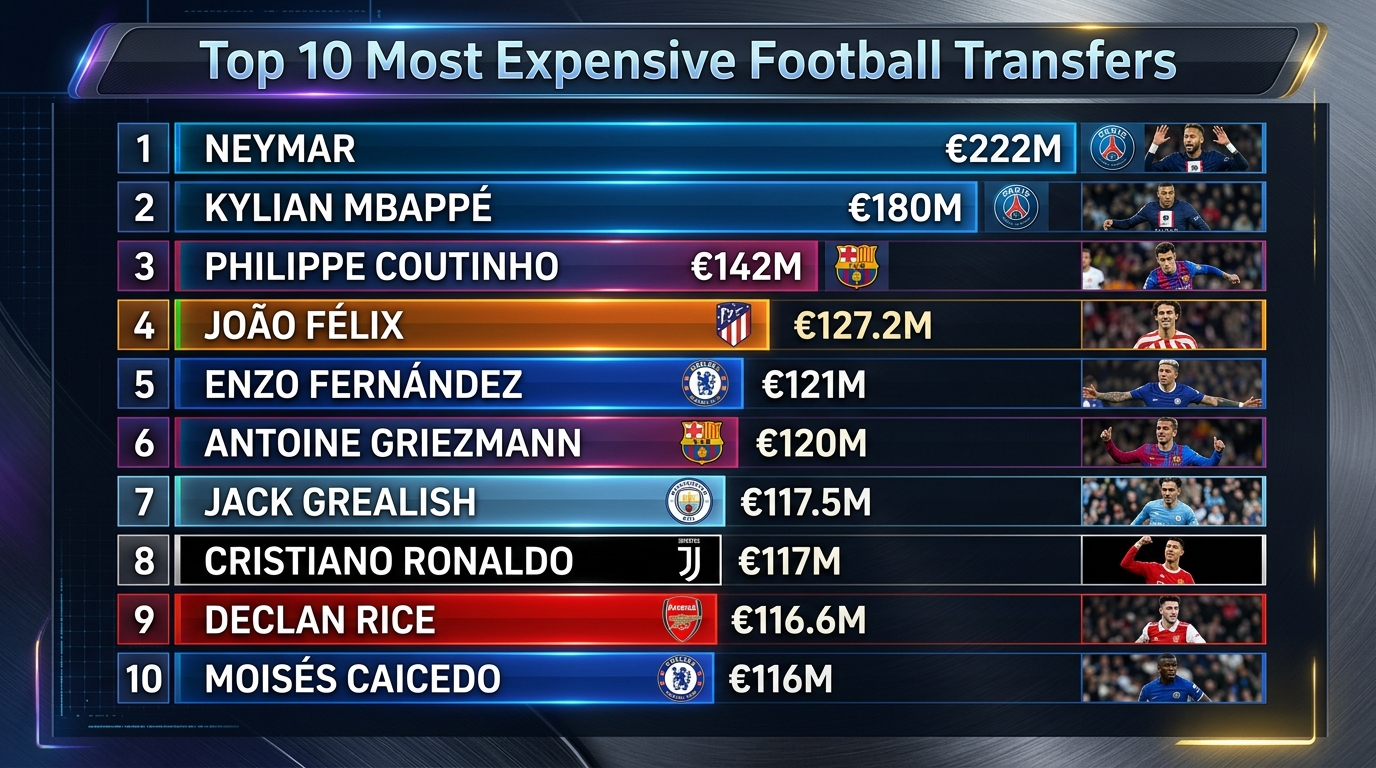
- Neymar (2017): Barcelona → PSG, €222 million
- Kylian Mbappé (2018): Monaco → PSG, €180 million
- Philippe Coutinho (2018): Liverpool → Barcelona, €142 million
- João Félix (2019): Benfica → Atlético Madrid, €127 million
- Enzo Fernández (2022): Benfica → Chelsea, €121 million
- Harry Kane (2023): Tottenham → Bayern Munich, €100 million
- Paul Pogba (2016): Juventus → Manchester United, €105 million
- Antoine Griezmann (2019): Atlético Madrid → Barcelona, €120 million
- Florian Wirtz (2025): Bayer → Liverpool, €125 million
- Ousmane Dembélé (2017): Borussia Dortmund → PSG, €105 million
Regional Dominance
Premier League clubs dominate expensive transfers:
- Manchester City: €1.5 billion spent on 69 players (2010-2020)
- Chelsea: Second-biggest Premier League spender
- Manchester United: Multiple €100M+ transfers
- Arsenal: Recent €100M+ investments
The Premier League’s financial power stems from broadcasting revenue, commercial deals, and global fanbase.
What’s Next? FIFA’s Groundbreaking 2026 Reform
Historic Transfer System Overhaul
In June 2026, FIFA announced the most significant reform of the transfer system in over two decades. This groundbreaking overhaul will fundamentally alter player transfers worldwide.
Key Changes Starting January 1, 2027
1. Mandatory Release Clauses
- All professional contracts must include release clauses
- Practice long-established in Spanish football becomes universal
- Prevents clubs from retaining players against their wishes
- Facilitates free transfers with predetermined amounts
2. Player Fee Share
- Players receive 5% of their transfer fee directly
- Mandatory for players earning over €30,000 annually
- Percentage cannot drop below greater of:
3. Youth Contract Extensions
- Under-18 players can sign five-year contracts (previously three)
- Requires specific registration periods
- Salary criteria must be met
- Clubs limited to limited long-term youth contracts per season
4. Enforcement Measures
- 8% interest rate on delayed payments
- Football Tribunal oversees compliance
- FIFPRO withdraws all lawsuits against FIFA
Impact on Transfer Fees
These reforms could reduce transfer fees by:
- Making player movements more predictable
- Reducing negotiation delays
- Increasing player bargaining power
- Preventing excessive “holdout” fees
President Gianni Infantino stated these changes minimize “drawn-out transfer negotiations and legal conflicts over player valuations”.
FAQ Section: Common Questions About Football Transfer Fees
1. What was the first ever football transfer fee?
The first recorded transfer fee was £100 in the late 1800s. However, Alf Common’s 1905 transfer for £1,000 became the first officially recorded £1,000+ transfer, marking football’s transition to professional business.
2. Why have transfer fees increased so dramatically?
Four main factors drove the explosion:
- Broadcasting deals: Premier League’s £10 billion deal (2022-25)
- Commercial revenue: Merchandise and sponsorship doubling
- Globalization: Expanded fanbase into Asia and Americas
- Wage pressure: Top players earning €400,000+ weekly
Transfer fees increased 40-fold since 1990 in the Premier League alone.
3. What is the highest transfer fee ever paid?
Neymar’s €222 million transfer from Barcelona to PSG in 2017 remains the all-time record. Of the 30 most expensive transfers, 29 occurred in the past decade.
4. Are transfer fees inflated compared to player value?
This debate continues among experts. Critics argue fees exceeded sustainable levels, with a €10 million player in 2009 costing €11.2 million today (12.1% above normal inflation). Supporters counter that football’s global revenue increased 100-fold, justifying premium pricing for unique talent.
5. How will FIFA’s 2026 reforms affect transfer fees?
The mandatory release clauses and player fee shares could reduce fees by making transfers more predictable and reducing negotiation delays. Reforms take effect January 1, 2027, marking the most significant change in over 20 years.
6. Which country spends the most on transfers?
English clubs dominate globally with $7.23 billion (£5.26 billion) in net transfer spend (2010-2020), far exceeding China ($1.46 billion), Spain ($1.12 billion), and Germany ($0.98 billion).
7. Do players receive money from their transfer fees?
Under FIFA’s 2026 reforms, players will receive 5% of their transfer fee directly. This is mandatory for players earning over €30,000 annually and represents a historic change. Previously, players received no direct transfer fee compensation.
Conclusion: The Unstoppable Rise of Football Transfer Fees
From £100 in 1905 to €222 million in 2017, football transfer fees have undergone the most dramatic transformation in sports history. This isn’t simple inflation—it’s a complete restructuring of football into a billion-dollar global business.
Key Takeaways
The scale of growth is unprecedented:
- Transfer fees increased 40-fold since 1990 in the Premier League
- 29 of the 30 most expensive transfers occurred in the past decade
- £38 billion ($48.5 billion) spent worldwide over the past decade
- English clubs dominated with $7.23 billion in net spending
The drivers are clear:
- Broadcasting revenue exploded with Sky/BT’s £3 billion deals
- Commercial income doubled through merchandise and sponsorships
- Global fanbase expanded into Asia and Americas
- Wage inflation forced clubs to pay premium transfer fees
The future is uncertain:
FIFA’s 2026 reforms introducing mandatory release clauses and player fee shares could stabilize or reduce fees starting January 1, 2027. Whether this ends the era of €100 million+ transfers remains to be seen.
The question isn’t whether football transfer fees have changed—they’ve exploded beyond any historical precedent. The question is whether this growth is sustainable or if the market will eventually correct.

My name is Jeferson, a passionate football enthusiast and the creator of this portal dedicated to fans of the world’s most popular sport. My goal is to provide reliable information, up-to-date news, match analysis, transfer updates, tournament coverage, and everything happening both on and off the pitch.