Understanding High Pressing: Why It Works and When It Fails
|
Getting your Trinity Audio player ready... |
The whistle blows, and instantly, three forwards sprint toward the opposition’s defenders. The crowd roars as a misplaced pass is intercepted on the edge of the penalty area, resulting in a lightning-fast goal.
This is the thrilling, chaotic, and heavily calculated world of high pressing.
Over the last decade, football has undergone a tactical revolution. Gone are the days when elite teams would simply retreat into their own half, form two rigid banks of four, and passively wait for the opposition to attack.
Today, the modern game is defined by proactive, suffocating intensity. From the English Premier League to the UEFA Champions League, high pressing has become the ultimate weapon for managers looking to dominate space and dictate the tempo.
But what exactly makes this aggressive strategy so effective? Is it just about running harder than the opponent, or is there a deep, underlying science to the madness? And more importantly, what happens when the press is broken and it all goes horribly wrong?
In this comprehensive guide, we will break down the mechanics of high pressing, explore its evolution, and uncover why it works—and when it fails.
5. Main Content
What is High Pressing in Football?
At its core, high pressing is a defensive tactic executed high up the pitch, usually in the opposition’s defensive third.
The primary goal is not just to win the ball back, but to win it back as close to the opponent’s goal as possible. By applying immense physical and spatial pressure on defenders and the goalkeeper, the pressing team aims to force a turnover in a highly dangerous area.
High pressing requires the entire team to move as a cohesive unit. If the forwards press but the midfield stays deep, massive gaps open up. Therefore, a high press demands a high defensive line, compressing the space the opponent has to play in.
It is a high-risk, high-reward strategy. When executed perfectly, it looks like an unstoppable swarm. When executed poorly, it leaves the pressing team completely exposed.
The Evolution of the High Press
To truly grasp the concept of high pressing, we must look at how it evolved. The tactic did not appear overnight; it is the result of decades of tactical innovation.
The Origins: Total Football
The roots of modern pressing can be traced back to the 1970s and Rinus Michels’ iconic Ajax and Netherlands teams.
Known as “Total Football,” Michels’ philosophy demanded that players seamlessly swap positions. To make this work, they had to win the ball back rapidly. When they lost possession, players would swarm the ball carrier, using an offside trap to squeeze the pitch.
Arrigo Sacchi’s AC Milan
In the late 1980s, Arrigo Sacchi took Michels’ concepts and added relentless defensive rigor. Sacchi’s AC Milan dominated European football by maintaining a maximum of 25 meters between their strikers and their defenders.
This incredible compactness meant the opposition had absolutely no space to breathe. Sacchi proved that pressing was not just about energy; it was about geometry and controlling space.
The Modern Era: Klopp and Guardiola
The modern interpretation of the press is largely defined by two managerial titans: Jurgen Klopp and Pep Guardiola.
Klopp popularized Gegenpressing (counter-pressing) at Borussia Dortmund and Liverpool, treating the moment of transition as the best playmaker on the pitch. Guardiola, meanwhile, refined the positional press at Barcelona, Bayern Munich, and Manchester City, using strict numerical superiority to trap opponents against the touchline.
Core Triggers: When Do Teams Press?
A common misconception among beginner football fans is that pressing teams run constantly for 90 minutes. This is physically impossible.
Instead of pressing aimlessly, intelligent teams use “pressing triggers.” These are specific in-game situations that signal the entire team to aggressively close down the opponent.
Bad Touches and Poor Body Shape
If an opposition defender takes a heavy touch, the pressing team immediately pounces.
Similarly, if a player receives the ball facing their own goal, they are incredibly vulnerable. They cannot see the attackers coming, making it the perfect trigger to swarm them from behind and force an error.
Passes to the Full-Backs
One of the most common pressing traps occurs when the ball is played to a full-back near the touchline.
Tactically speaking, the touchline acts as an extra defender. The full-back’s passing angles are immediately restricted by 180 degrees. Pressing teams will intentionally leave the pass to the full-back open, wait for the ball to travel, and then instantly collapse on the receiver, cutting off all inside passing lanes.
Goal Kicks and Deep Build-Up
With modern rules allowing defenders to receive the ball inside the penalty area from a goal kick, deep build-up play has become standard.
Pressing teams view this as a prime opportunity. By matching up man-to-man on the edge of the box, they dare the goalkeeper to make a risky, pinpoint pass under immense pressure.
Why High Pressing Works
When deployed effectively, high pressing is devastating. Here is why it has become the gold standard for top-tier football clubs.
Creating High-Quality Chances
The closer you win the ball to the opponent’s goal, the fewer passes you need to score.
When a team wins the ball back in the attacking third, the opponent’s defense is usually expanded, attempting to build up play. They are entirely out of shape. A quick interception immediately results in a one-on-one situation or a simple square pass for a tap-in.
Disrupting Opponent Rhythm
Some teams rely heavily on slow, methodical build-up play to dictate the tempo of a match. High pressing shatters this rhythm.
By denying the opponent’s holding midfielder time on the ball, pressing teams force long, inaccurate clearances. This allows the pressing team to easily recover the ball and launch their own sustained attacks, creating a suffocating wave of pressure.
Psychological Dominance
There is a severe psychological toll to facing a relentless press.
Defenders and goalkeepers know that a single mistake could cost their team the game. As the pressure mounts, anxiety sets in. This mental fatigue often leads to forced errors, misplaced passes, and a complete breakdown in the opponent’s tactical plan.
The Anatomy of a Successful Press
A functional high press requires highly specialized roles. It is an intricate machine where every cog must turn in unison.
The Initiator (The Striker)
The striker is the tip of the spear. Players like Roberto Firmino or Gabriel Jesus are heavily valued not just for their goal-scoring, but for their pressing intelligence.
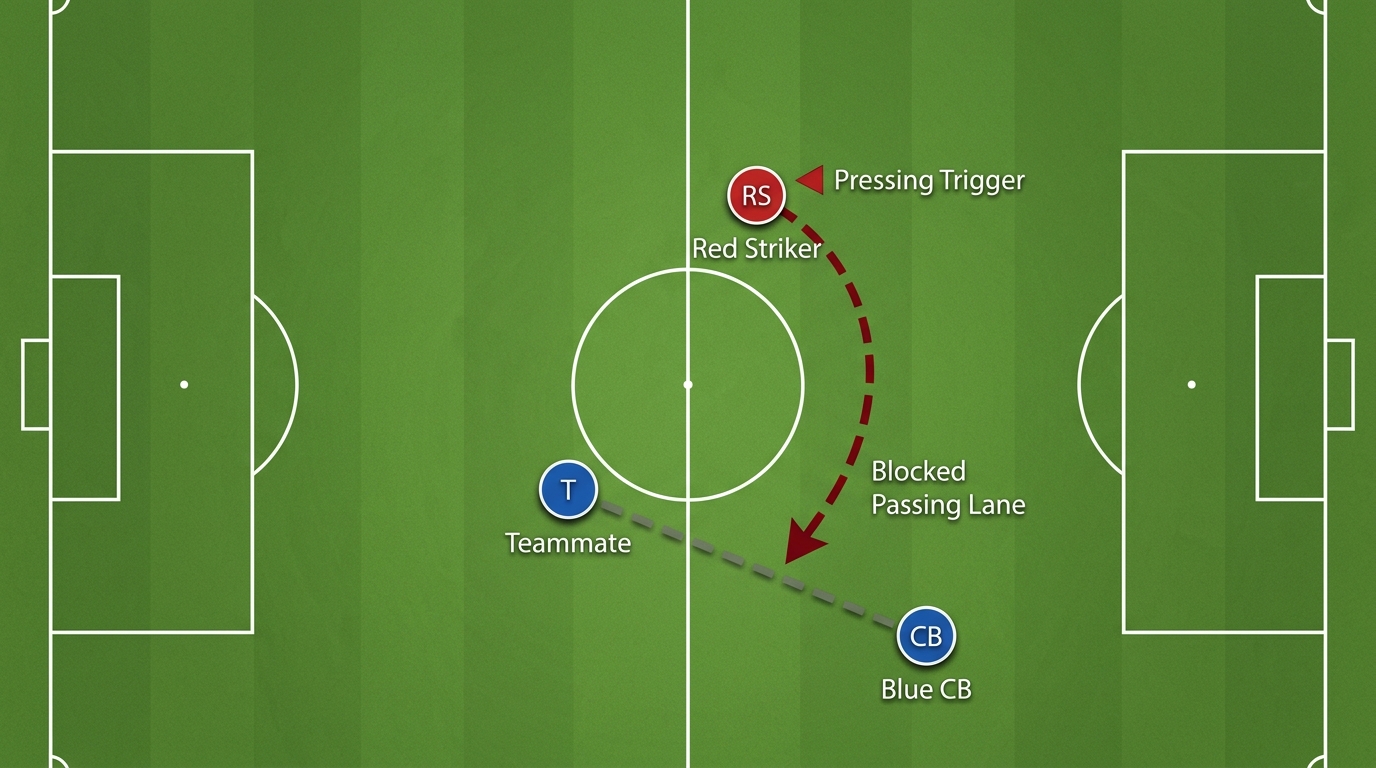
The striker’s job is often to “curve” their run. By pressing the center-back in an arcing motion, they block the passing lane to the other center-back, forcing the play down one specific side of the pitch.
The Chasers (Wingers and Midfielders)
Once the striker forces the play in a specific direction, the wingers and central midfielders spring the trap.
They must aggressively close down the immediate passing options. Midfielders like N’Golo Kanté or Bernardo Silva excel here, using their stamina and anticipation to intercept passes aimed at the opposition’s pivots.
The Sweeper Keeper (The Safety Net)
You cannot play a high press without a high defensive line, and you cannot play a high defensive line without a sweeper-keeper.
Because the defenders push up to the halfway line to compress the space, a massive void is left behind them. Goalkeepers like Manuel Neuer, Ederson, and Alisson Becker act as the ultimate safety net, rushing out of their penalty areas to clear long balls played over the top.
When High Pressing Fails
Despite its massive popularity, high pressing is not infallible. It comes with structural vulnerabilities that smart opponents can brutally exploit.
The Threat of the Long Ball
The most direct way to beat a high press is to simply bypass it.
If an opposition team has a physically dominant striker (a target man) and runners willing to chase second balls, they can launch the ball directly from the goalkeeper to the attacking third. Because the pressing team has committed players forward, losing the physical battle for the long ball leaves their defense incredibly exposed.
Fatigue and Fitness Drops
High pressing demands supreme cardiovascular conditioning.
Even the fittest teams in the world struggle to maintain a high press for a full 90 minutes. If a team’s energy levels drop in the 70th minute, the pressing structure becomes disjointed. A split-second delay in closing down a player allows the opponent to play right through the middle of the pitch.
Elite Press Resistance
The absolute kryptonite to a high press is a team composed of elite, press-resistant technical players.
Midfielders like Sergio Busquets, Rodri, or Toni Kroos possess the vision and close control to invite pressure and calmly pass through it. If a pressing team commits five players forward and the opponent successfully passes through them, the pressing team is suddenly caught in a disastrous 5-on-3 counter-attack.
Notable High-Pressing Systems
Different managers have developed unique flavors of the high press. Here is a look at three distinct tactical variations.
Jurgen Klopp’s Gegenpressing
Klopp’s philosophy is centered around the immediate transition.
Instead of dropping back when possession is lost, Klopp’s teams counter-press instantly. The goal is to win the ball back within five seconds of losing it, catching the opponent in their most disorganized state. It relies heavily on explosive pace and overwhelming numbers around the ball.
Pep Guardiola’s Positional Press
Guardiola’s press is less about heavy metal chaos and more about geometric domination.
His teams press to maintain possession. They use strict positional play to ensure that if the ball is lost, players are already stationed in the exact right zones to lock the opponent in. It is a highly systemic, possession-oriented approach to defending.
Marcelo Bielsa’s Man-to-Man Chaos
Marcelo Bielsa employs a radical man-to-man high press.
Unlike Klopp or Guardiola, who primarily press zones and passing lanes, Bielsa assigns his players specific men to follow across the entire pitch. It creates frantic, highly entertaining football that forces individual duels all over the field, testing the absolute physical limits of his squad.
6. FAQ Section
What is the difference between high pressing and Gegenpressing? High pressing refers to a team’s organized defensive structure starting high up the pitch when the opponent has established possession (e.g., from a goal kick). Gegenpressing (counter-pressing) occurs specifically in the immediate seconds after a team loses the ball, attempting to win it back before the opponent can transition into an attack.
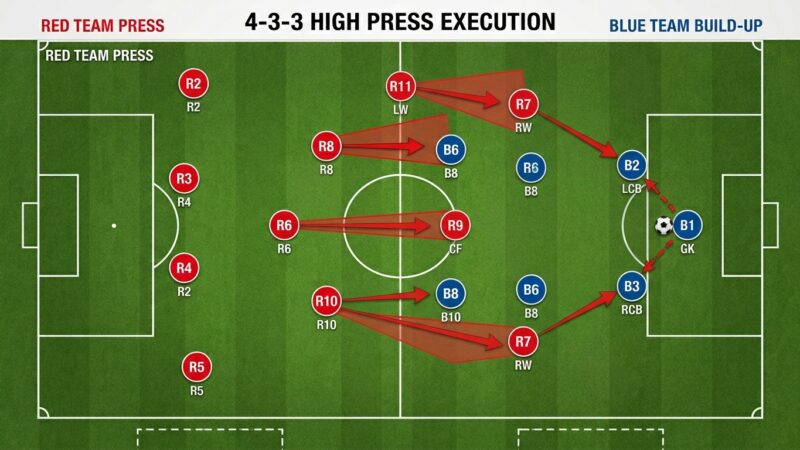
Which formation is best for high pressing? While various formations can be used, the 4-3-3 is the most popular for high pressing. It naturally provides a front three to press the opponent’s backline, while the three central midfielders can push up to suffocate the center of the pitch. The 4-2-3-1 is also highly effective due to the presence of an attacking midfielder who can join the striker to form a front two.
How do teams successfully beat a high press? Teams beat a high press using two main methods. The first is utilizing press-resistant technical players who can execute “third-man runs” and quick, one-touch passing triangles to play through the pressure. The second method is going direct, using accurate long balls to a strong target man, completely bypassing the midfield where the press is heavily concentrated.
Does high pressing cause more player injuries? Statistically, high-pressing systems demand higher sprint distances and greater physical exertion. If not managed properly through squad rotation and sports science, this can lead to muscular fatigue and a higher risk of soft-tissue injuries, particularly during congested fixture schedules like the winter period in the Premier League.
Can amateur or Sunday League teams use a high press? While they can try, it is incredibly difficult. A successful high press requires elite tactical coordination, supreme fitness levels, and a goalkeeper comfortable sweeping outside their box. In amateur football, teams often lack the unified structure, resulting in a disjointed press that is easily bypassed by a simple ball over the top.
7. Conclusion
High pressing is far more than just a physical endeavor; it is a complex, intellectual game of chess played at a hundred miles per hour.
From the visionary mind of Rinus Michels to the modern touchline theatrics of Jurgen Klopp and Pep Guardiola, the high press has reshaped how we view defensive football. It proves that the best way to defend your own goal is often to aggressively attack the opponent’s.
However, as we have explored, it is not a flawless system. It demands perfection. A single missed trigger, a momentary lapse in fitness, or a moment of genius from a press-resistant midfielder can cause the entire structure to collapse.
Understanding these mechanics elevates the way you watch the game. The next time you see a striker arc their run toward a center-back, or a team intentionally leave a full-back open, you will know exactly what trap is being set.
If you enjoyed this tactical breakdown, be sure to explore more of our deep-dive football content across the site. Whether you want to understand the evolution of the false nine or master the intricacies of the low block, we have all the tactical analysis you need to view the beautiful game like a pro manager.

My name is Jeferson, a passionate football enthusiast and the creator of this portal dedicated to fans of the world’s most popular sport. My goal is to provide reliable information, up-to-date news, match analysis, transfer updates, tournament coverage, and everything happening both on and off the pitch.