Champions League Format Explained for Brazilian Fans: League Phase, Knockouts and Qualification
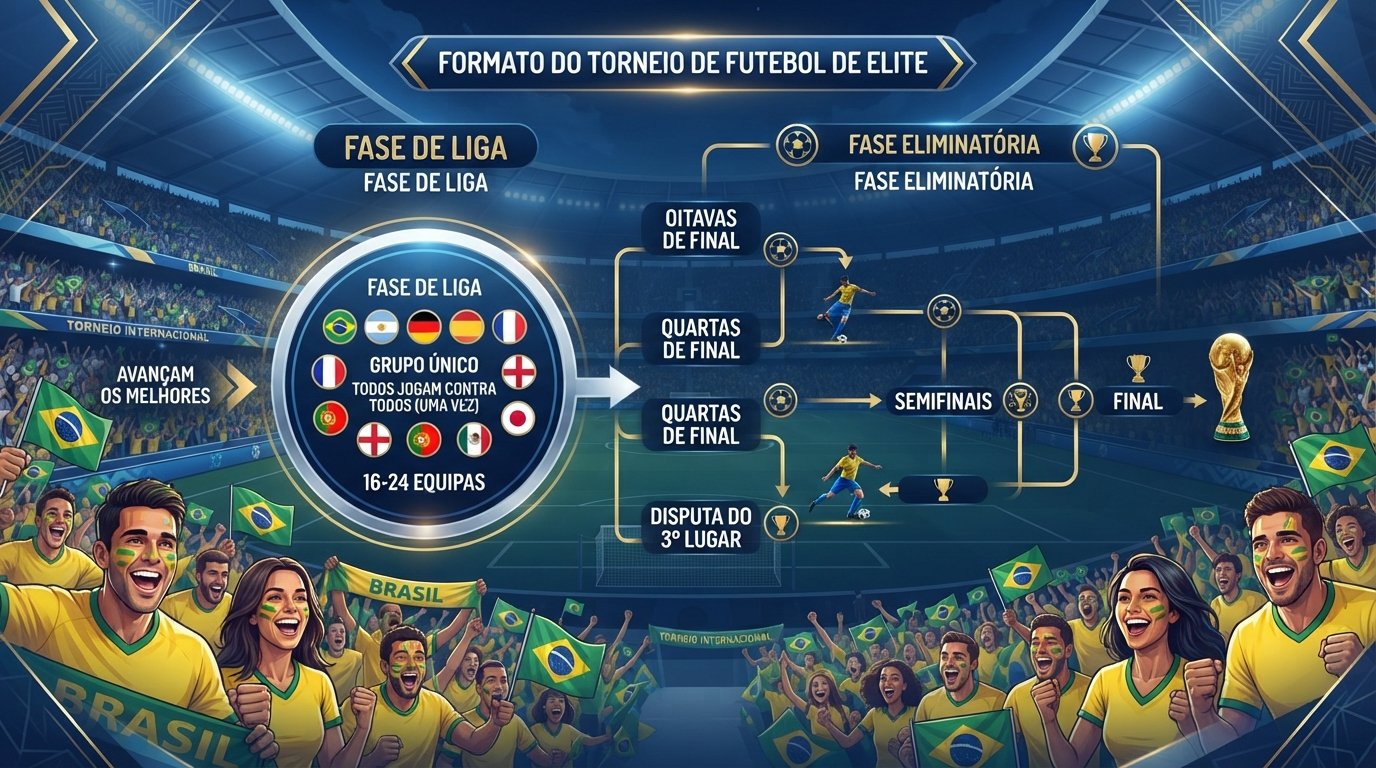
The UEFA Champions League is no longer organised as a traditional group stage. Since the 2024/25 edition, 36 clubs share one league table, each club plays eight league-phase matches, and the final position determines whether the next step is the round of 16, a knockout play-off or elimination. That change is important for Brazilian fans because the competition now produces meaningful table movement in every matchweek rather than six fixtures against only three group opponents.
This guide explains the system in plain terms, using practical examples and the terminology used by UEFA. The rules below are based on UEFA’s format announcement, the current access-list information. UEFA can amend details from one season to the next, so the regulations for the relevant edition remain the final authority.
What replaced the old group stage?
The old model had 32 teams divided into eight groups of four. Each club played six group matches, home and away against the other three teams. The new model has 36 clubs in one combined league phase.
There are no separate Groups A through H. Every participant appears in the same table, even though no club plays all 35 opponents.
Each team plays eight different opponents. Four matches are at home and four are away. The draw places the 36 clubs into four seeding pots.
A club receives two opponents from each pot: one match against a team from that pot at home and one away. This gives a supporter more varied match-ups while preserving a broad balance in the draw. It also means that a strong club can face several elite opponents before the knockout rounds begin.
The scoring remains familiar: a win is worth three points, a draw one point and a defeat zero. After all eight matches, UEFA ranks all 36 teams together. A club’s league-phase position is not a decorative statistic; it decides its route into the knockout bracket.
How the league-phase table creates four different outcomes
| Final position | What happens next | Meaning for the fan |
|---|---|---|
| 1st–8th | Direct qualification for the round of 16 | Two fewer matches are needed before the last 16. |
| 9th–16th | Knockout-phase play-off, against a team placed 17th–24th | The club must survive a two-legged tie to reach the last 16. |
| 17th–24th | Knockout-phase play-off, against a team placed 9th–16th | The club still has a route forward, but starts against a seeded opponent. |
| 25th–36th | Elimination from the Champions League | There is no automatic transfer to the Europa League from this league phase. |
Positions 1 to 8 are therefore especially valuable. Those clubs bypass the play-off and wait for the round of 16. Teams in positions 9 to 16 are seeded in the play-off draw and, in principle, play the second leg at home.
Clubs in positions 17 to 24 are unseeded. The eight play-off winners join the top eight in the round of 16.
For a simple example, imagine three clubs finishing with these records. Club Aurora wins five, draws one and loses two, giving it 16 points and a place in the top eight. Club Brisa wins four, draws two and loses two, collecting 14 points and finishing 12th; it must play the knockout play-off.
Club Costa wins three, draws one and loses four, taking 10 points and finishing 27th; its European campaign ends in this competition. The exact cut-off changes with the season, because the table is determined by results and the applicable tie-break rules, not by a permanent points target.
What is the knockout play-off?
The play-off is a bridge between the league phase and the round of 16. A team ranked ninth to 16th is paired with a team ranked 17th to 24th. The tie is played over two legs, one in each stadium.
The aggregate score across both matches decides who advances. There is no advantage for the old away-goals rule; UEFA’s modern knockout procedures use the overall score and, when necessary, extra time and a penalty shoot-out under the competition regulations.
Consider a practical example. Suppose Club Norte finishes 11th and Club Sul finishes 20th. Norte is seeded, so it is drawn against Sul or another club from the lower band.
If Norte wins 2–1 away and draws 0–0 at home, its aggregate score is 2–1 and it reaches the round of 16. If the two clubs are level after the return leg, extra time and penalties may be required. A single bad night is damaging, but a two-leg tie rewards the team that performs better across both fixtures.
The top-eight finishers then meet the eight play-off winners in the round of 16. From that stage, the competition continues through the quarter-finals and semi-finals to the final. The knockout rounds before the final are played over two legs, while the final is a single match at a neutral venue selected by UEFA.
The high-level structure is unchanged: win each tie, or win the final, to become champion.
How clubs qualify for the Champions League
Qualification begins before the league phase and is connected to two ideas: a club’s domestic league performance and its national association’s UEFA coefficient position. The access list determines how many places each European association receives and at which stage its clubs enter. In practical terms, finishing higher in a strong domestic league usually provides a direct route, while champions from lower-ranked associations may need to pass through qualifying rounds.
UEFA separates the early route into a champions path and a league path. The champions path is designed for domestic champions from associations whose clubs do not all enter directly. The league path serves certain non-champion clubs that qualify through their domestic standings.
The exact entrants and round assignments vary by season, so a fan should consult the relevant access list instead of assuming that every country sends its second- or fourth-place club to the same round.
Qualifying ties are normally two-legged knockout contests. UEFA’s regulation says each team plays the opponent twice, at home and away, and the club with the greater aggregate of goals qualifies. A draw may place a seeded club against an unseeded club, with club-coefficient rankings used for seeding.
Clubs eliminated in qualifying can be redirected to an ongoing UEFA club competition according to the applicable regulations, but that is different from the league-phase rule: a team finishing 25th or lower in the Champions League league phase does not simply drop into the Europa League.
What this means for Brazilian fans
Brazil is not a UEFA member association, so a Brazilian domestic club cannot qualify for the Champions League through the Brasileirão or the Copa do Brasil. Brazilian supporters usually follow the tournament through European clubs, Brazilian players, or clubs owned and supported by Brazilian communities. A Brazilian forward scoring in Madrid, Manchester or Munich does not change the eligibility of that European club: the place belongs to the club and is earned through its UEFA association and domestic competition.
This distinction also helps when comparing continental competitions. CONMEBOL Libertadores has its own entry system and group or league-stage rules, while the Champions League is administered by UEFA. A fan who sees a Brazilian club described as a “champion” should ask: champion of which confederation, and under which competition regulations? The answer determines the route.
The Champions League titleholder and the UEFA Europa League titleholder also have specific access protections and rebalancing rules, which UEFA publishes for each season.
There is a useful viewing habit for Brazilian audiences. First, check the league-phase table rather than looking only at points. Second, note the band: top eight, play-off zone or elimination zone.
Third, check the draw’s pairings and the venue order. Finally, separate a club’s European position from the reputation of an individual Brazilian player. A star’s form may influence a match, but the competition’s qualification logic is collective and regulatory.
A quick match-night checklist
- Before the game: identify the club’s current position and its remaining opponents.
- After a win: add three points, then watch how other results affect the single table.
- Near the final matchday: compare the club with positions eight, 16, 24 and 25, because those borders change the next stage.
- For a play-off: assess the aggregate score across both legs, not just the result of the first match.
- For qualification: verify the season-specific access list and regulations, because association rankings and titleholder scenarios can alter entry.
The simplest way to remember the format
Think of the Champions League as one 36-team league followed by a merit-based funnel. Eight clubs go straight to the round of 16. Sixteen clubs compete for the other eight places in two-legged play-offs.
Twelve clubs are eliminated after the league phase. Before that league phase, domestic performance and UEFA’s access list decide who enters directly and who must qualify. For Brazilian fans, that framework removes the most common confusion: there is one table, eight league-phase matches per club, no automatic Europa League safety net after a bottom-12 finish, and a clear reward for placing as high as possible.
Editorial note: This explainer distinguishes the general competition structure from season-specific access decisions. For fixtures, standings, draw procedures and any regulatory amendment, use UEFA’s official competition pages and the regulations linked above. That habit gives supporters a reliable reference when headlines or social-media summaries simplify the format too aggressively.
References
UEFA Champions League: Competition format
UEFA: New format for Champions League post-2024
UEFA Champions League Regulations: Match system for qualifying phase and play-offs
UEFA rankings: Access list (men’s)
UEFA Champions League: Official standings

My name is Jeferson, a passionate football enthusiast and the creator of this portal dedicated to fans of the world’s most popular sport. My goal is to provide reliable information, up-to-date news, match analysis, transfer updates, tournament coverage, and everything happening both on and off the pitch.