Loading ...

How Football Transfer Windows Work in Europe and Brazil

How Football Transfer Windows Work in Europe and Brazil

Transfer-window deadline day looks chaotic on television, but the underlying system is deliberately structured. A club can scout a player, negotiate terms and even announce an agreement before the player is legally eligible to represent the new team. The decisive step is registration: the relevant football association must record the player during an authorised period and the competition must accept the resulting squad entry.

This distinction explains why a deal can be “done” in the news yet unavailable on the pitch.

This guide separates the headline-making negotiation from the regulatory work that makes a transfer valid. It compares the general European model with Brazil’s calendar, follows a move from agreement to eligibility, and uses practical examples. Dates change by season and competition, so readers should verify the current notice from the applicable association rather than rely on a generic transfer-calendar graphic.

What a transfer window actually controls

In everyday language, a transfer window is the period in which clubs may register incoming players. FIFA’s official explanation makes clear that each member association sets registration periods for its professional men’s and women’s competitions, within the framework of the

The first, normally the long pre-season window, lasts between eight and 12 weeks; the mid-season period lasts between four and eight weeks; together they may not exceed 16 weeks.

A window is therefore not a general ban on footballers changing jobs. It is a registration-control mechanism designed to protect sporting integrity and contractual stability. A club may continue to negotiate, extend a contract, or agree that a player will arrive when a contract expires.

What it usually cannot do is register that incoming player for domestic competition after its association’s deadline has passed. Exceptional rules exist, but they are narrow and competition-specific.

From agreement to an eligible player: the real sequence

A typical professional transfer has several linked stages:

  1. Recruitment and permission. The buying club identifies a target and, where the player is under contract, approaches the current club through the permitted channel.
  2. Contractual agreement. The selling club and buying club agree the transfer, while the player and new club agree employment terms. A medical examination, work authorisation and other conditions may still be outstanding.
  3. Registration submission. The new club sends the required documents to its national association before the applicable cut-off. This is the administrative race that makes deadline day tense.
  4. International clearance, when needed. For a cross-border move, the associations coordinate an International Transfer Certificate (ITC). FIFA’s international-transfer guide explains that the Transfer Matching System (TMS) is compulsory for international transfers and that accurate entries support the FIFA Clearing House.
  5. Competition eligibility. The domestic league, cup or continental organiser applies its own squad-list and eligibility rules. Registration with the national association alone does not automatically place the player on every competition list.

FIFA’s rules also illustrate why timing matters. For an international transfer, the new association generally requests the ITC through the system, and the player is not eligible for the new club until the required registration and system steps are complete. In other words, a signed contract is evidence of an employment relationship; it is not, by itself, a licence to play in the next match.

How the European model works in practice

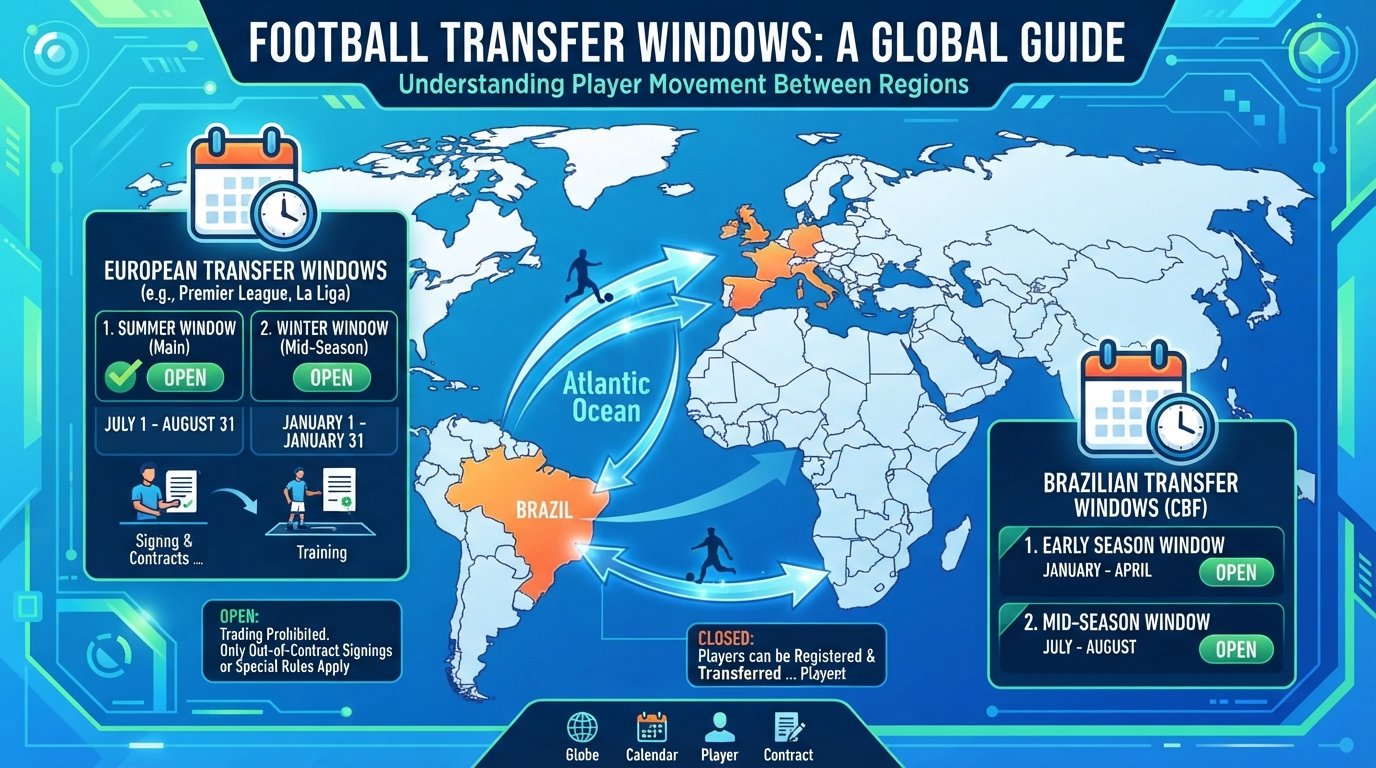
Europe does not have one single domestic window. England, Spain, Italy, Germany and France each publish their dates, while UEFA adds a separate layer for its club competitions. The familiar pattern is a long summer market and a shorter January market.

The Premier League’s official explainer notes that the summer window lasts close to three months and the January window about one month.

Summer gives clubs time to reshape a squad and integrate new signings during pre-season; January is a mid-season repair shop, often used to cover injuries, replace a departure or respond to a change of coach.

Windows in different associations can also close on different dates. That creates a useful but easily misunderstood possibility: a club in one country may be unable to register a new player while still selling or loaning a player to a country whose window remains open, subject to the rules of both associations. Announcing a future arrival is another example.

If a player’s contract expires on 30 June, a club may announce that he will join on 1 July, but the announcement does not bring forward the player’s registration or match eligibility.

European club competitions create an additional deadline. Under How Brazil’s calendar differs

Brazil operates under the same broad FIFA framework but applies it to a calendar that begins with state championships and then moves through national competitions. The registration-and-transfer regulations portal is the appropriate starting point for the detailed Brazilian requirements. In Brazil, a transfer may involve the player’s registration in the CBF system, documentation supplied by the club and, for an international move, the FIFA process as well. A player can be contractually signed yet unavailable if the registration was not completed in time or if the competition’s own inscription limit has been reached.

Brazil’s calendar can make a January-to-March window especially significant because clubs are building squads around a new domestic cycle. The July-to-September period is different: it occurs during national competition and can be used to correct weaknesses revealed by the opening months. For example, imagine a Série A club agreeing in August to sign a defender from another Brazilian club.

The clubs may settle their contract terms immediately, but the defender still needs the CBF registration to be processed before the second window closes. If the same player comes from abroad, international clearance adds another dependency.

Three practical deadline examples

Example one: an English club and a Brazilian player. An English club reaches an agreement with a Brazilian club on the final day of England’s window. The player cannot simply board a plane and play that weekend.

The English club must submit its domestic registration, while the associations complete the international transfer record and ITC steps. A missing document or late system entry can leave the contract signed but the player ineligible.

Example two: a European player announced in June. A Premier League team announces a midfielder whose existing contract ends on 30 June. The announcement is a communication decision; the legal sporting move begins when the contract expires and the player is registered.

Supporters should not interpret the social-media announcement as permission for the player to appear in a match before the relevant registration date.

Example three: a Brazilian signing and a continental list. A Brazilian club completes a domestic signing during the CBF window, then discovers that its continental competition list has a different deadline or a fixed squad limit. The player may be available for a Série A match but absent from the continental list, unless the competition’s later-registration provision applies.

This is why squad planning treats domestic and international calendars as connected but separate workstreams.

A reliable way to read transfer news

When assessing a reported deal, identify the country of the buying club, the player’s current registration, the competition in which the player is expected to appear, and the exact deadline time zone. Then distinguish “agreement,” “medical completed,” “contract signed,” “registration submitted,” “ITC issued” and “squad list approved.” These phrases describe different checkpoints.

FIFA’s regulations, the national association’s registration notice and the competition organiser’s rules are more reliable than an unsourced countdown post.

The central lesson is simple: a transfer window governs eligibility, not just headlines. Europe’s two-window model is decentralised across associations and supplemented by UEFA lists; Brazil applies the FIFA framework through CBF dates and national registration procedures. Once fans understand the difference between a deal and a completed registration, deadline-day drama becomes easier to follow—and much harder to misinterpret.

Editorial note: This article explains the general framework for educational purposes. Registration dates, exceptions, squad limits and competition eligibility can change, so clubs and players should rely on the current rules issued by FIFA, the relevant national association and the competition organiser.

Jeferson

My name is Jeferson, a passionate football enthusiast and the creator of this portal dedicated to fans of the world's most popular sport. My goal is to provide reliable information, up-to-date news, match analysis, transfer updates, tournament coverage, and everything happening both on and off the pitch.

Deixe um comentário

O seu endereço de e-mail não será publicado. Campos obrigatórios são marcados com *