Premier League Table Explained: Points, Tie-Breakers, Europe and Relegation
The Premier League table is more than a list of clubs arranged from first to 20th. It is a live record of results, a ranking system for the title race, and a route map for European qualification and relegation. The table becomes especially important when two clubs have the same points, when a domestic cup changes the European places, or when a single final-day goal moves a team above the relegation line.
This guide explains how to read every important column, how points are calculated, which tie-breakers decide equal totals, and why the meaning of a league position can change after the FA Cup or EFL Cup is completed. The framework follows the Premier League’s own competition explanation and European qualification guidance, with UEFA and EFL sources linked for the rules that sit outside the league table itself.
What the Premier League table measures
Twenty clubs compete in a double round-robin season. Each team plays every other club once at home and once away, producing 38 matches per club and 380 matches overall. The final ranking is determined by sporting results, not by reputation, wage bill, possession or transfer spending.
A club earns its position by accumulating points and then applying the competition’s tie-break rules when necessary.
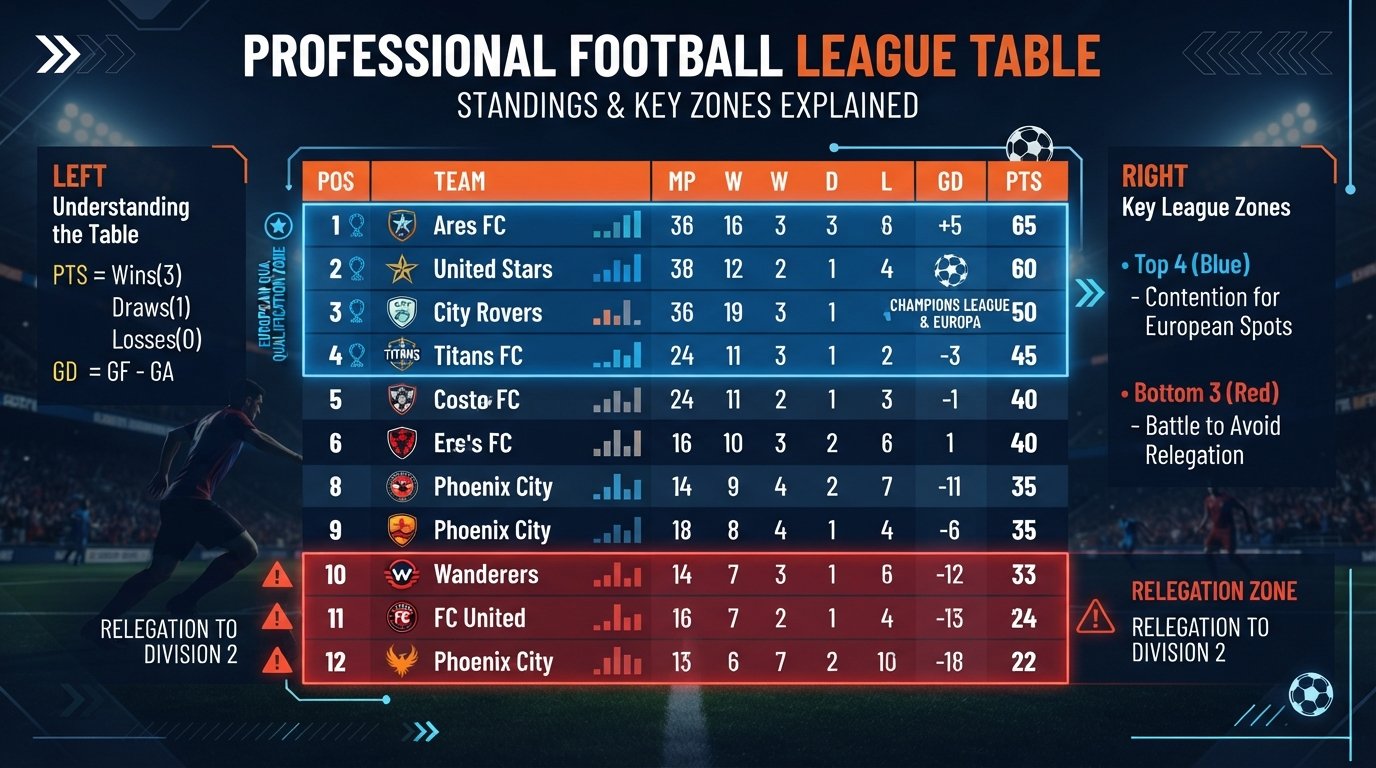
The table usually shows these abbreviations:
| Column | Meaning | How to interpret it |
|---|---|---|
| Pos | Position | The club’s current rank from first to 20th. |
| P | Played | Matches completed. |
| W, D, L | Wins, draws and losses | The team’s result record. |
| GF | Goals for | Total goals scored. |
| GA | Goals against | Total goals conceded. |
| GD | Goal difference | GF minus GA. |
| Pts | Points | The primary ranking measure. |
A live table is provisional. Clubs may have played different numbers of matches because of postponements, so comparing points alone can be misleading in mid-season. The official How points are awarded The basic system is simple: a win earns three points, a draw earns one point for each club, and a defeat earns zero. The match result is established by the goals scored in the game; there is no extra-time or penalty shoot-out in a normal Premier League fixture. The Football Association’s What happens when clubs finish level? Points come first. If clubs have equal points, the Premier League’s published order uses goal difference, then goals scored, followed by head-to-head measures between the tied teams. The head-to-head stage considers points gained in the relevant meetings and then away goals in those meetings. Readers should check the competition’s current regulations for the precise application when more than two clubs are tied, because formal rules can govern how a mini-table is constructed.
| Order | Criterion | Example question |
|---|---|---|
| 1 | Points | Who has the larger total from wins and draws? |
| 2 | Goal difference | Who has the larger value after subtracting GA from GF? |
| 3 | Goals scored | Who has scored more goals overall? |
| 4 | Head-to-head points | Who collected more points in the meetings between the tied clubs? |
| 5 | Head-to-head away goals | Who scored more away goals in those meetings? |
Consider a practical example. Club A and Club B each finish with 68 points. Club A has scored 61 and conceded 38, giving it a +23 goal difference.
Club B has scored 55 and conceded 30, giving it a +25 goal difference. Club B ranks higher even though Club A scored more goals, because goal difference is assessed first. If their goal differences were also equal, the next comparison would be total goals scored.
Goal difference is not the same as goals scored. A team that wins 4–0 and loses 0–1 has a +3 goal difference. A team that wins 1–0 twice has a +2 goal difference, even though both teams have scored two goals.
This is why late goals can change a table without changing the points earned.
How league positions create European opportunities
European qualification is not a permanent promise attached to one numbered position. It depends on the UEFA access list, the Premier League’s allocation, and the winners of domestic and UEFA competitions. The Premier League’s explanation of association coefficients shows why the number of Champions League places can vary.
UEFA assesses the collective results of clubs from each national association across its competitions. Because access rules may change, fans should use the current Premier League and UEFA announcements rather than relying on an old infographic or a previous season’s table.
How relegation and promotion work
The bottom three Premier League clubs at the end of the season are relegated to the EFL Championship. Relegation is based on final table position, so a club that is 18th, 19th or 20th after all matches are completed goes down, subject to any exceptional regulatory decision. There is no relegation play-off in the Premier League.
The three replacements come from the Championship. The Championship’s first- and second-placed clubs earn automatic promotion. The teams finishing third, fourth, fifth and sixth enter the EFL play-offs for the final promotion place.
The EFL’s official play-off explanation describes two-legged semi-finals and a one-off final at a neutral venue. The final winner moves into the Premier League.
Here is a practical survival example. Suppose 17th place has 38 points, 18th has 37, and 19th has 36 before the final day. A win is worth three points, so a club starting 18th can finish above 17th if it wins and the higher club loses.
If both finish on the same points, goal difference and the later tie-breakers decide the order. A draw may be enough for survival if the club below it cannot collect the required points, but the table must be recalculated after every result.
How to read the table during a season
Start with matches played. A team in fourth with 20 matches completed may not be in a stronger position than a team in sixth with 22 matches played. Then compare points per match as a rough context measure, while remembering that the official table ranks total points, not projections.
Check the gap to the next relevant line: the title lead, the Champions League places, the Europa League or Conference League range, and 17th place above relegation.
Next, inspect the schedule and goal difference. A small points gap can disappear quickly, but a large goal-difference advantage can act as an additional point in a tie. Finally, confirm whether a cup final, European title or UEFA access-list update changes the qualification picture.
The table is the starting point; the regulations determine what each position ultimately means.
Bottom line
The Premier League table is built on a clear hierarchy: three points for a win, one for a draw, then goal difference and further tie-breakers when totals match. The final positions decide the champion and the bottom three, while European places also reflect domestic cup winners, UEFA performance and access-list rules. Understanding those layers makes the table easier to read and prevents common mistakes, such as treating fifth place as a fixed European destination or assuming that goals scored always outrank goal difference.
Authoritative sources
This article is an original explainer based on the primary sources below. Competition access rules can change, so readers should verify the applicable season before making a definitive prediction.
- Premier League: format, points, tie-breakers, Europe, promotion and relegation
- Premier League: European qualification explained
- UEFA: how association club coefficients are calculated
- IFAB Laws of the Game, Law 10: determining the outcome of a match
- English Football League: about the play-offs

My name is Jeferson, a passionate football enthusiast and the creator of this portal dedicated to fans of the world’s most popular sport. My goal is to provide reliable information, up-to-date news, match analysis, transfer updates, tournament coverage, and everything happening both on and off the pitch.