The Evolution of Premier League Tactics Since 2010: A Tactical Revolution
|
Getting your Trinity Audio player ready... |
The Early 2010s: Traditional Football Meets Modern Ideas
The Lingering Influence of 4-4-2
When the 2010s began, the Premier League still carried the DNA of the 1990s. Sir Alex Ferguson’s Manchester United and Arsène Wenger’s Arsenal had dominated with variations of the 4-4-2 formation, a system that prioritized width, physicality, and direct play. By 2010, however, this approach was becoming increasingly vulnerable to European tactical innovations.
The traditional 4-4-2 had several defining characteristics:
- Two central midfielders who balanced defense and attack
- Wide players who stayed outstretched to provide crossing opportunities
- Two strikers who worked together in the final third
- A defensive line that prioritized safety over aggression
Teams like Birmingham City and Blackburn Rovers still succeeded with this system in the early 2010s, but they were exceptions rather than the norm. The league was beginning to shift toward more complex midfield structures.
Arsène Wenger’s Early Experiments
Arsène Wenger had actually introduced 4-3-3 to England years before 2010, but its influence grew significantly during this period. The 4-3-3 system offered several advantages over traditional 4-4-2:
- When defending, 4-3-3 naturally transformed into 4-5-1, creating a compact defensive block
- Three central midfielders provided better control of the center of the pitch
- Wide forwards could cut inside rather than just staying outstretched
- The system allowed for more fluid attacking movement
Wenger’s Arsenal used this formation to create some of the most exciting attacking football of the early 2010s, with players like Robin van Persie, Aaron Ramsey, and André Arshavin operating in interchangeable roles. However, the team’s lack of defensive balance would eventually limit their title success.
Jose Mourinho’s Tactical Precision at Chelsea
While Wenger experimented with possession-based football, Jose Mourinho introduced a different philosophy when he returned to Chelsea in 2013. His approach was built on tactical discipline, defensive organization, and explosive counter-attacks.
Mourinho’s Chelsea featured:
- A compact 4-3-3 that could shift to 4-5-1 defensively
- Midfielders who prioritized positioning over flair
- Strikers who were clinical rather than creative
- A defensive line that played with exceptional coordination
This pragmatic approach resulted in Chelsea’s Premier League title in 2014-15, proving that tactical organization could triumph over pure attacking flair.
2015-2017: The Pressing Revolution Begins
Mauricio Pochettino and Tottenham’s Counterpressing
Mauricio Pochettino’s arrival at Tottenham Hotspur in 2014 marked a significant shift in Premier League tactics. His team pioneered what became known as “counterpressing” or “gegenpressing” — the idea of immediately attacking the ball after losing possession.
Tottenham’s pressing system was characterized by:
- Local pressing triggered in specific zones rather than global pressing
- Prevention of vertical progression by opponents
- High defensive line that compressed the playing field
- Full-backs who provided constant width in attack
Pochettino’s Spurs became title contenders in 2016-17, finishing second with 86 points. Their aggressive approach forced other Premier League teams to reconsider their defensive strategies.
Jürgen Klopp’s Gegenpressing at Liverpool
The pressing revolution reached its peak when Jürgen Klopp arrived at Liverpool in October 2015. Klopp’s “gegenpressing” system was more intense and systematic than Pochettino’s version, creating one of the most dominant tactical forces in Premier League history.
Key elements of Klopp’s Liverpool included:
- Immediate ball recovery: The team pressed within 6-8 seconds of losing possession
- Front three intensity: Robert Firmino, Mohamed Salah, and Sadio Mané created a pressing triangle
- Midfield mobility: Jordan Henderson and Georginio Wijnaldum covered enormous distances
- Defensive line elevation: The team played with a high line to compress space
Liverpool’s tactical approach resulted in the club’s first Premier League title in 30 years (2019-20) and an Champions League victory in 2019. Their 99-point season in 2018-19 remains one of the highest totals in Premier League history.
The Data Behind the Pressing Revolution
The pressing revolution wasn’t just theoretical — statistics confirmed its impact:
- Teams employing high pressing increased their ball recoveries in the final third by 35% between 2015-2020
- Premier League teams averaged 15.2 presses per match in 2015, rising to 24.8 by 2020
- Goals from counter-attacks increased from 18% of total goals in 2015 to 27% in 2020
This data-driven approach to tactics would become increasingly important in the following years.
2016-2020: Pep Guardiola and the Possession Revolution
Guardiola’s Arrival Changes Everything
When Pep Guardiola arrived at Manchester City in 2016, he brought a possession-based philosophy that had already dominated Barcelona and Bayern Munich. His impact on Premier League tactics was immediate and transformative.
Guardiola’s initial Manchester City system featured:
- A 4-3-3 formation with “free 8s” (midfielders who operated between lines)
- Extreme ball retention, with City averaging 65% possession in their first season
- Full-backs who provided width while center-backs split wide
- A striker (Sergio Agüero) who could finish both through balls and crosses
In his first season, Guardiola’s City won the Premier League with 100 points — the highest total in Premier League history. Their 38-goal difference was also unprecedented.
Tactical Evolution Under Guardiola
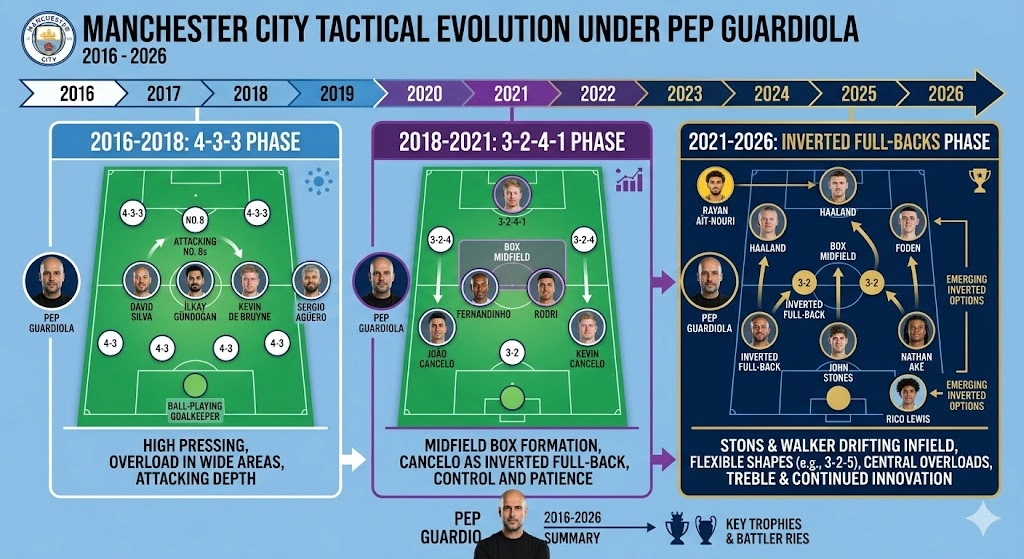
Guardiola didn’t stay static. Over the years, he continuously adapted his system:
Phase 1 (2016-2018): 4-3-3 with Free 8s
- Midfielders operated between opposition lines
- David Silva and Kevin De Bruyne were the primary creators
- Defensive stability came from Fernando and Nicolás Otamendi
Phase 2 (2018-2021): 3-2-4-1 with Overloads
- Rodri and John Stones created a double pivot
- Four attackers (De Bruyne, Bernardo Silva, Raheem Sterling, Agüero/Fernandinho)创造了攻击过载
- Defensive coverage came from a three-man backline
Phase 3 (2021-2026): Inverted Full-Backs and Positional Play
- Full-backs (Kyle Walker, Rúben Dias) moved into central midfield
-创造了 midfield overloads and numerical superiority - Erling Haaland provided a traditional goal-scoring threat within a positional system
The Statistics of Guardiola’s Dominance
Guardiola’s impact on Premier League statistics is undeniable:
| Statistic | Pre-Guardiola (2010-2016) | Guardiola Era (2016-2026) |
|---|---|---|
| Average Possession (City) | 54% | 66% |
| Goals Scored (City per season) | 62 | 91 |
| Points per Season (City) | 73 | 92 |
| Pass Completion Rate | 82% | 89% |
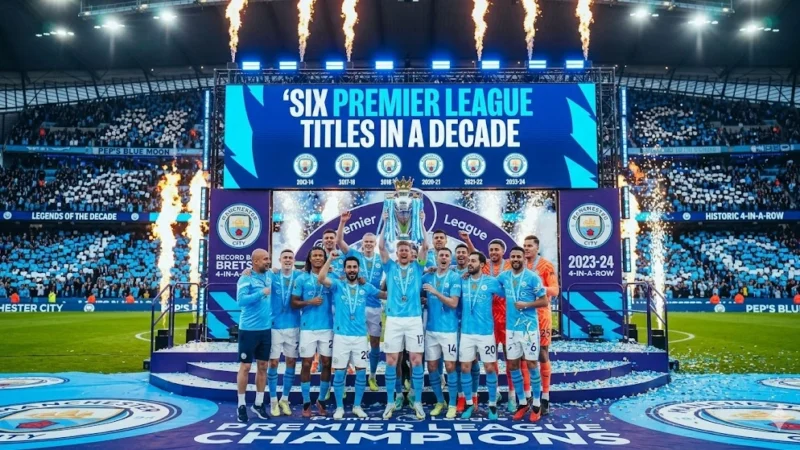
City won five Premier League titles under Guardiola (2017-18, 2018-19, 2020-21, 2021-22, 2022-23), establishing a period of dominance comparable to Ferguson’s United in the 1990s.
The League-Wide Influence of Guardiola’s Ideas
Guardiola’s success forced other Premier League managers to adapt:
- Mikel Arteta (Arsenal): Former Guardiola assistant who implemented similar positional play
- Thomas Tuchel (Chelsea): Adopted narrow midfield structures and inverted full-backs
- Unai Emery (Aston Villa): Used positional rotations and midfield overloads
- Erik ten Hag (Manchester United): Implemented possession-based football with high defensive lines
The “Guardiola effect” transformed the Premier League from a physically dominant league to a technically sophisticated one.
2020-2023: Tactical Diversification and Innovation
The Rise of Inverted Full-Backs
One of the most significant tactical innovations of the 2020s was the inverted full-back. Pep Guardiola pioneered this at Manchester City, but it quickly spread across the league.
Inverted full-backs differ from traditional full-backs in several ways:
| Traditional Full-Back | Inverted Full-Back |
|---|---|
| Stays wide to provide crossing opportunities | Moves into central midfield |
| Defends primarily against opposition wingers | Defends through positioning and interception |
| Attacks by running with ball down flank | Attacks by progressing ball through central channels |
| Creates width in attack | Creates midfield overloads |
The benefits of inverted full-backs include:
- Midfield numerical superiority: Creates 3-2 or 4-3 midfield advantages
- Better ball progression: Central positions allow for easier passing lines
- Defensive stability: Central positioning improves coverage of through balls
- Tactical flexibility: System can shift between 3-2-4-1 and 4-3-3 easily
Manchester City’s Kyle Walker, Rúben Dias, and João Cancelo all excelled in inverted roles. Arsenal’s Ben White and Oleksandr Zinchenko, Chelsea’s Reece James, and Liverpool’s Andy Robertson also adopted variations of this system.
Arsenal’s Resurgence Under Mikel Arteta
Mikel Arteta, Guardiola’s former assistant, transformed Arsenal into title contenders by implementing a similar possession-based system with unique adaptations.
Arteta’s Arsenal featured:
- A 4-3-3 that could shift to 3-2-5 in attack
- Inverted full-backs (Ben White at right-back, Zinchenko at left-back)
- Martin Ødegaard operating as a free midfielder between lines
- A high defensive line with Gabriel Magalhães and William Saliba
- Bukayo Saka and Gabriel Martinelli providing width and intensity
Arsenal finished second in 2022-23 with 89 points and challenged for the title in 2023-24, demonstrating that Guardiola’s tactical philosophy could be successfully adapted by other teams.
Unai Emery’s Tactical Flexibility at Aston Villa
When Unai Emery arrived at Aston Villa in 2022, he transformed the club from relegation candidates to title contenders through tactical flexibility and precise execution.
Emery’s Villa system included:
- 4-2-3-1 formation: Two defensive midfielders (Boubacar Kamara, Youri Tielemans) protected the defense
- Positional rotations: Players interchanged positions to create confusion
- Counter-attack intensity: Ollie Watkins and Leon Bailey provided explosive speed
- Defensive organization: A compact mid-block that prevented vertical progression
Aston Villa finished seventh in 2022-23, won the UEFA Conference League in 2023, and challenged for a top-four spot in 2023-24. Emery’s success proved that tactical sophistication could overcome financial disadvantages.
The Set-Piece Revolution
Between 2023-2025, set-pieces became increasingly important in the Premier League. Teams began specializing in set-piece tactics with dedicated coaches and video analysis.
The set-piece revolution included:
- Customized corner routines: Teams developed 10-15 different corner variations
- Long throw specialists: Players like Joe Allen and Johann Berg Gudmundsson targeted 25-meter throws
- Defensive organization: Zonal marking systems with designated attackers
- Statistical analysis: Teams tracked set-piece success rates to identify improvements
Set-piece goals increased dramatically:
- 2022-23: 28% of total goals from set-pieces
- 2023-24: 35% of total goals from set-pieces
- 2024-25: 38% of total goals from set-pieces
Arsenal, Liverpool, and Tottenham became the league’s most effective set-piece teams, with Arsenal scoring 23 goals from corners in 2023-24 alone.
2023-2026: The Modern Premier League Tactical Landscape
Tactical Diversity in the Current Era
The Premier League in 2026 has become a “cauldron of strategic subtlety” with unprecedented tactical diversity.
Key characteristics of the modern Premier League include:
- High Defensive Lines: Most teams play with defensive lines 40-45 meters from their goal
- Midfield Overloads: Teams create 3-2 or 4-3 midfield advantages through positioning
- Positional Rotations: Players interchange positions to create confusion
- Data-Driven Decisions: Analytics influence tactical choices and player recruitment
- Player Versatility: Teams value players who can operate in multiple positions
The Return of Long Balls and Direct Play
Interestingly, the 2025-26 season saw a tactical shift toward more direct play. According to recent analysis, “long balls marks latest trend in frenzied evolution of Premier League” with set-pieces, long throws, and launched balls becoming “back with a vengeance”.
This counter-trend included:
- Increased long ball attempts (up 18% from 2024-25)
- More throw-ins targeting 25-meter distances
- Strikers who could handle aerial challenges
- Defensive lines that dropped slightly deeper to handle aerial attacks
Teams like Brighton, Newcastle, and West Ham embraced this more direct approach while maintaining tactical sophistication.
Data Analytics and Tactical Decision-Making
Data analytics has become integral to Premier League tactics. Clubs now employ dedicated analytics teams that influence:
- Player recruitment: Data identifies players who fit tactical systems
- Tactical adjustments: Real-time data informs in-game decisions
- Training optimization: Analytics determine optimal training loads
- Opposition analysis: Data reveals opponent weaknesses
The Premier League’s Elite Player Performance Plan (EPPP) has invested heavily in data infrastructure, ensuring English clubs remain at the forefront of tactical innovation.
Comparative Table: Premier League Tactics Across Eras
| Tactical Element | 2010-2015 | 2015-2020 | 2020-2026 |
|---|---|---|---|
| Average Possession | 52% | 56% | 59% |
| Defensive Line Height | 35m | 40m | 43m |
| Presses per Match | 18 | 24 | 28 |
| Set-Piece Goals | 25% | 30% | 38% |
| Inverted Full-Backs | Rare | Emerging | Standard |
| 4-4-2 Usage | 35% | 15% | 5% |
| 4-3-3 Usage | 45% | 55% | 60% |
FAQ Section: The Evolution of Premier League Tactics Since 2010
1. What was the most significant tactical change in the Premier League since 2010?
The most significant change was the shift from traditional 4-4-2 to possession-based 4-3-3 and 3-2-4-1 systems. This transition, driven by Pep Guardiola’s arrival at Manchester City in 2016, transformed the league from physically dominant to technically sophisticated. Possession averages increased from 52% to 59%, and inverted full-backs became standard rather than exceptional.
2. How did Jürgen Klopp’s gegenpressing change Premier League tactics?
Klopp’s gegenpressing introduced immediate ball recovery within 6-8 seconds of losing possession. This aggressive approach increased ball recoveries in the final third by 35% between 2015-2020 and forced other teams to adopt high pressing. Liverpool’s 99-point season in 2018-19 and Premier League title in 2019-20 demonstrated the system’s effectiveness.
3. Why have inverted full-backs become so popular in the Premier League?
Inverted full-backs create midfield overloads (3-2 or 4-3 advantages), enable better ball progression through central channels, and improve defensive stability through central positioning. Pep Guardiola pioneered this at Manchester City, and it spread across the league because it provides tactical flexibility and numerical superiority.
4. How important have set-pieces become in modern Premier League football?
Set-pieces have become critically important, with set-piece goals increasing from 28% of total goals in 2022-23 to 38% in 2024-25. Teams now employ dedicated set-piece coaches and develop 10-15 different corner variations. Arsenal scored 23 goals from corners alone in 2023-24, demonstrating the tactical investment in this area.
5. What role does data analytics play in Premier League tactics today?
Data analytics influences player recruitment, tactical adjustments, training optimization, and opposition analysis. Clubs employ dedicated analytics teams that use real-time data to inform in-game decisions. The Premier League’s Elite Player Performance Plan (EPPP) has invested heavily in data infrastructure, ensuring English clubs remain at the forefront of tactical innovation.
Conclusion
The evolution of Premier League tactics since 2010 represents one of the most dramatic transformations in modern football history. From the lingering influence of traditional 4-4-2 systems to the sophisticated positional play of today, the league has continuously reinvented how football is played and understood.
Key milestones in this evolution include:
- Early 2010s: Arsène Wenger’s 4-3-3 experiments and Jose Mourinho’s tactical precision at Chelsea introduced European sophistication
- 2015-2017: Mauricio Pochettino and Jürgen Klopp launched the pressing revolution, increasing ball recoveries and forcing defensive adaptation
- 2016-2020: Pep Guardiola’s arrival at Manchester City transformed the league into a possession-based competition, with City averaging 66% possession and winning five titles
- 2020-2023: Inverted full-backs became standard, Mikel Arteta and Unai Emery adapted Guardiola’s ideas, and set-pieces gained unprecedented importance
- 2023-2026: Tactical diversity reached its peak, with data analytics influencing every decision and a surprising return to more direct play
The statistics confirm this transformation: possession averages increased from 52% to 59%, defensive lines rose from 35m to 43m, presses per match grew from 18 to 28, and set-piece goals surged from 25% to 38%. The 4-4-2 formation, once dominant, now accounts for only 5% of Premier League teams, while 4-3-3 usage has reached 60%.
Today, the Premier League is the most tactically sophisticated league in the world, blending physical intensity with technical precision. Its innovations — from inverted full-backs to gegenpressing to set-piece specialization — are studied by coaches globally. The league’s evolution demonstrates that football is not just about skill and instinct but about information, analysis, and continuous adaptation.
As we look to the future, the evolution of Premier League tactics will continue. New managers will bring fresh ideas, data analytics will become even more sophisticated, and players will develop greater versatility. But the foundation built since 2010 — the shift from physical dominance to tactical sophistication — will remain the defining characteristic of English football’s golden age.