The Most Successful Free Transfers in Football History
|
Getting your Trinity Audio player ready... |
Imagine securing a world-class football superstar without spending a single penny on transfer fees. It sounds like a dream for any club director, but in the modern era of the beautiful game, it happens more frequently than you might think.
Since the landmark Bosman ruling changed the landscape of football contracts forever, the free transfer has become a highly tactical, financially lucrative weapon for Europe’s elite clubs. A well-timed free transfer can alter the balance of power in an entire league, shifting titles and defining eras without requiring a record-breaking transfer budget.
While clubs routinely splash hundreds of millions on unproven talent, history shows us that sometimes the best things in life—and in football—truly are free. From defensive monoliths crossing intense local divides to playmaking maestros reviving their careers, these zero-cost acquisitions have delivered unparalleled returns on investment.
In this comprehensive guide, we will explore the most successful free transfers in football history, analyzing the players, the context of their moves, and the undeniable impact they left on their new clubs.
What is the Bosman Ruling? The Birth of the Free Transfer
Before we dive into the greatest free transfers of all time, it is vital to understand how these moves became possible. The term “free transfer” is intrinsically linked to the “Bosman ruling,” a monumental legal decision that shook the foundations of football in 1995.
Jean-Marc Bosman, a relatively obscure Belgian midfielder, wanted to move from RFC Liège to the French side Dunkerque upon the expiration of his contract in 1990. However, at the time, clubs retained the registration rights of players even after their contracts ended. Liège demanded an exorbitant transfer fee, which Dunkerque refused to pay, leaving Bosman stranded and his wages drastically reduced.
Bosman took his case to the European Court of Justice. In 1995, the court ruled in his favor, stating that the existing transfer rules violated the European Union’s laws on the free movement of workers.
The ruling established a new standard: once a player’s contract with a club expires, they are completely free to negotiate and sign with any other club within the EU without their former employer receiving a transfer fee. It also allowed players entering the final six months of their contracts to sign pre-contract agreements with foreign clubs. This decision shifted massive financial and negotiating power into the hands of the players and their agents, giving birth to the modern transfer market.
The Financial Strategy Behind Free Transfers
A “free transfer” is rarely entirely free. While the purchasing club avoids paying a transfer fee to another team, the financial outlay is still significant.
Because there is no transfer fee involved, agents and players hold immense leverage during contract negotiations. This typically results in:
- Massive Signing-On Fees: The player and their agent demand a lump sum payment just for choosing the club.
- Inflated Wages: The club uses the money saved on the transfer fee to offer the player a higher weekly salary than they might otherwise receive.
Despite these hidden costs, the overall financial package usually remains highly favorable for the acquiring club. For example, signing a top-tier striker might cost £80 million in transfer fees plus wages. Signing a comparable striker on a free transfer might cost a £15 million signing bonus and slightly higher wages, ultimately saving the club tens of millions while instantly upgrading their squad.
Let’s look at the players who proved to be the ultimate bargains.
The 8 Most Successful Free Transfers in Football History
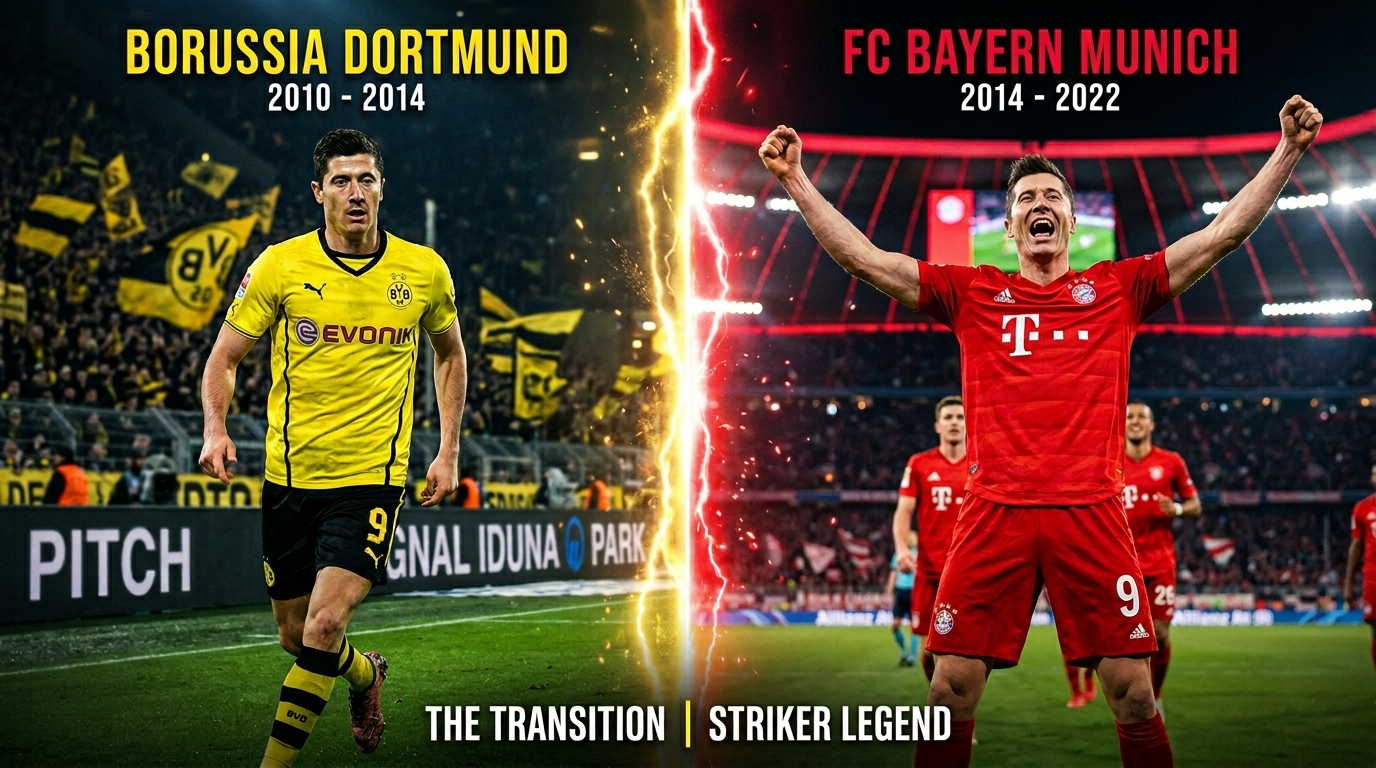
1. Robert Lewandowski (Borussia Dortmund to Bayern Munich, 2014)
It is arguably the most devastating free transfer in the history of European football. Robert Lewandowski had already established himself as one of the best strikers in the world at Borussia Dortmund, winning two Bundesliga titles under Jürgen Klopp and scoring four goals in a single Champions League semi-final against Real Madrid.
When he refused to sign a new contract, Dortmund made the difficult decision to keep him for the final year of his deal rather than cash in, knowing he would leave for nothing. In the summer of 2014, he walked straight into the arms of their fiercest rivals, Bayern Munich.
What followed was an era of unprecedented dominance. Lewandowski became the ultimate goalscoring machine for the Bavarians, breaking records that many believed would stand forever—including Gerd Müller’s historic record for the most goals in a single Bundesliga season (41 goals).
Lewandowski’s Impact at Bayern Munich:
| Competition | Appearances | Goals | Trophies Won |
| Bundesliga | 253 | 238 | 8 |
| Champions League | 78 | 69 | 1 |
| DFB-Pokal | 33 | 29 | 3 |
| Total | 375 | 344 | 19 Total Honors |
Lewandowski left Bayern for Barcelona in 2022 for a reported €45 million. Bayern got eight prime years of the world’s best striker for zero transfer fee, and then sold him for a massive profit. It is the gold standard of free transfers.
2. Andrea Pirlo (AC Milan to Juventus, 2011)
In the summer of 2011, AC Milan made a catastrophic error in judgment. Believing that a 32-year-old Andrea Pirlo was past his physical prime and no longer fit for their tactical setup, they allowed the legendary playmaker’s contract to expire. Juventus, who had been struggling to reclaim their status as Italy’s premier club following the Calciopoli scandal, swooped in.
Pirlo’s arrival in Turin was a paradigm shift. Operating as a deep-lying playmaker, or Regista, Pirlo dictated the tempo of games with a serene elegance that belied his age. He became the architect of a new Juventus dynasty under manager Antonio Conte.
In his four seasons at the club, Pirlo led Juventus to four consecutive Serie A titles. Legendary goalkeeper Gianluigi Buffon described the signing as “the deal of the century.” Pirlo not only resurrected his own career—cementing his legacy as one of the greatest midfielders of his generation—but he also single-handedly dragged Juventus back to the absolute summit of Italian football.
3. Sol Campbell (Tottenham Hotspur to Arsenal, 2001)
If Lewandowski’s move was devastating, Sol Campbell’s move was downright explosive. Crossing the North London divide is one of the biggest taboos in English football, and Campbell did it in the most dramatic fashion possible.
Campbell was the captain of Tottenham Hotspur, their academy graduate, and their most prized asset. He repeatedly assured Spurs fans that he would sign a new contract and stay at White Hart Lane. However, driven by a desire to play Champions League football and challenge for major trophies, Campbell quietly ran down his contract.
In a press conference where journalists were expecting Arsenal to announce the signing of goalkeeper Richard Wright, Arsène Wenger instead unveiled Sol Campbell. The shockwaves were felt across the Premier League.
Campbell immediately became the rock at the heart of Arsenal’s defense. He won two Premier League titles, three FA Cups, and was a foundational piece of the famous 2003–04 “Invincibles” team that went an entire league season completely undefeated. While he remains deeply unpopular in one half of North London, his trophy cabinet proves his controversial free transfer was a masterstroke.
4. James Milner (Manchester City to Liverpool, 2015)
Not all successful free transfers are flashy superstars; some are relentless engines of consistency. When James Milner arrived at Anfield in the summer of 2015 after his contract at Manchester City expired, the reaction was largely understated. He was viewed as a solid, sensible acquisition for a Liverpool side that was in transition.
What unfolded over the next eight years was nothing short of legendary. Milner became the ultimate Swiss Army knife for manager Jürgen Klopp. He played in central midfield, on the wings, and even spent an entire season as the team’s starting left-back.
Milner’s Core Achievements at Liverpool:
- Versatility: Played successfully in over 5 different positions.
- Fitness: Remained a core squad player into his late 30s.
- Trophies: Won the Premier League, Champions League, FA Cup, League Cup, UEFA Super Cup, and FIFA Club World Cup.
- Leadership: Served as the club’s vice-captain and primary penalty taker for several seasons, providing invaluable locker room leadership.
Milner made 332 appearances for Liverpool. His unrivaled work ethic and winning mentality helped transform Liverpool from challengers into undisputed champions of Europe and England.
5. Paul Pogba (Manchester United to Juventus, 2012)
This transfer is unique because it features the same player, the same two clubs, and an astonishing amount of money changing hands later on.
In 2012, a 19-year-old Paul Pogba was growing frustrated with a lack of first-team opportunities at Manchester United under Sir Alex Ferguson. Believing in his own immense potential, the young Frenchman refused to sign a new deal and departed for Juventus on a free transfer.
In Italy, Pogba blossomed into a global superstar. Surrounded by experienced midfield generals like Andrea Pirlo and Arturo Vidal, Pogba had the freedom to showcase his incredible athleticism, vision, and long-range shooting. He won four consecutive Serie A titles and helped Juventus reach the 2015 Champions League Final.
The ultimate twist in the tale came in 2016. Manchester United, desperate to reclaim their former glory, realized the error of their ways. They bought Pogba back from Juventus for a then-world-record fee of £89 million. Juventus had acquired a generational talent for nothing, enjoyed four years of his absolute peak, and then sold him back to the same club for an astronomical fortune. It is a masterpiece of transfer business.
6. Lionel Messi (Barcelona to Paris Saint-Germain, 2021)
For over two decades, the idea of Lionel Messi wearing a club shirt other than Barcelona’s seemed impossible. However, in the summer of 2021, a severe financial crisis at the Catalan club made it mathematically impossible for them to register Messi’s new contract while complying with La Liga’s strict salary cap rules.
The greatest player of all time was suddenly a free agent. Paris Saint-Germain acted swiftly, securing Messi’s signature in a move that sent shockwaves through the sporting world.
While Messi’s time in Paris drew mixed reactions regarding his on-pitch performances compared to his alien-like peak in Spain, the transfer was an undisputed success on multiple fronts:
- Sporting Impact: He contributed 32 goals and 35 assists in 75 matches across two seasons, winning back-to-back Ligue 1 titles and the Best FIFA Men’s Player award. Crucially, he also won the 2022 World Cup during his time as a PSG player.
- Commercial Explosion: Messi’s arrival generated an estimated €700 million in extra revenue for PSG in his first year alone. The club secured massive new sponsorship deals, saw a historic surge in merchandise sales, and gained tens of millions of new social media followers.
Though his tenure was short, the acquisition of Messi for a zero transfer fee remains one of the most culturally and financially significant moves in modern football.
7. Michael Ballack (Bayern Munich to Chelsea, 2006)
When Roman Abramovich purchased Chelsea, he was happy to spend heavily on transfer fees. But one of the club’s greatest ever signings cost them absolutely nothing.
Michael Ballack was the captain of the German national team and fresh off winning his third Bundesliga title in four seasons with Bayern Munich. In 2006, he chose to let his contract run down, sparking a fierce bidding war for his signature among Europe’s elite, including Manchester United and Real Madrid. Ballack chose Chelsea.
His presence added a layer of undeniable steel, experience, and leadership to an already formidable Chelsea midfield alongside Frank Lampard and Michael Essien. Over four seasons at Stamford Bridge, Ballack made 166 appearances, helping the club win a Premier League title, three FA Cups, and a League Cup, whilst also reaching the 2008 Champions League Final. He was the prototype of the modern, complete midfielder, and securing him on a free transfer was a major coup for the Blues.
8. Esteban Cambiasso (Real Madrid to Inter Milan, 2004)
Real Madrid’s Galácticos era was defined by signing the most marketable and attacking players in the world. Often, this strategy led to them overlooking the defensive workhorses that balanced the team. When Esteban Cambiasso’s contract expired in 2004, Madrid let the Argentine midfielder walk away for nothing. Inter Milan gladly picked him up.
It proved to be one of the best pieces of business in Italian football history. Cambiasso spent an incredible ten seasons at Inter, making 431 appearances. He became the tactical heartbeat of the team, renowned for his intelligence, tackling, and unmatched reading of the game.
His tenure culminated in the 2009–10 season under José Mourinho, where Cambiasso was instrumental in Inter Milan winning an unprecedented continental Treble (Serie A, Coppa Italia, and the UEFA Champions League). Real Madrid’s loss was the foundation of Inter Milan’s greatest modern era.
Honorable Mentions
The history of free transfers is so rich that several legendary moves narrowly miss out on the top 8.
- Zlatan Ibrahimović (PSG to Man United, 2016): Arriving in the Premier League at age 34, Zlatan scored 28 goals in his debut season, single-handedly carrying United to League Cup and Europa League triumphs before injury struck.
- Ruud Gullit (Sampdoria to Chelsea, 1995): A seminal moment in the Premier League’s history. Gullit’s arrival on a free transfer helped usher in a new era of cosmopolitan, glamorous football at Stamford Bridge.
- Jay-Jay Okocha (PSG to Bolton Wanderers, 2002): The Nigerian magician lit up the Premier League with his incredible flair, turning Sam Allardyce’s Bolton into one of the most entertaining sides in England.
Frequently Asked Questions (FAQ)
1. What exactly is a free transfer in football?
A free transfer occurs when a football player moves from one club to another without the new club having to pay a transfer fee to the old club. This happens almost exclusively when a player’s contract with their current employer expires, making them a “free agent.”
2. Do players actually play for free on a free transfer?
No, absolutely not. The term “free” only applies to the transfer fee between clubs. The player still receives a regular, often highly lucrative salary. In fact, players on free transfers usually demand higher wages and massive signing-on bonuses because the purchasing club is saving money on a transfer fee.
3. What was the Bosman ruling?
The Bosman ruling was a 1995 decision by the European Court of Justice involving Belgian player Jean-Marc Bosman. It banned restrictions on foreign EU players within national leagues and allowed players in the EU to move to another club at the end of their term without a transfer fee being paid.
4. When can a player negotiate a free transfer?
Under FIFA rules, a player entering the final six months of their contract is legally allowed to speak to foreign clubs and sign a pre-contract agreement to join them on a free transfer once their current deal expires.
5. Why do clubs sometimes allow great players to leave for free?
Clubs usually want to avoid this, but it happens for several reasons: the player may refuse all contract extension offers to force a move, the club might not be able to afford the player’s wage demands, or the club may feel the player is too old to warrant a long-term, high-paying contract.
Conclusion
The evolution of the free transfer has fundamentally altered how football clubs build championship-winning squads. While breaking the bank for a hundred-million-pound superstar captures the immediate headlines, history proves that the smartest business is often done in the shadows of expiring contracts.
From the ruthless efficiency of Robert Lewandowski in Germany to the enduring elegance of Andrea Pirlo in Italy, free transfers have consistently delivered some of the greatest sporting returns on investment ever seen. The Bosman ruling gave players the power of self-determination, but it gave clubs the ultimate opportunity to scout, strategize, and secure world-class talent without paying a premium.
As the football market continues to inflate with astronomical transfer fees, the art of securing a top-tier player for nothing will only become more valuable. The next time the transfer window opens, keep a close eye on the players running down their contracts—you might just be watching the next legendary free transfer unfold.

My name is Jeferson, a passionate football enthusiast and the creator of this portal dedicated to fans of the world’s most popular sport. My goal is to provide reliable information, up-to-date news, match analysis, transfer updates, tournament coverage, and everything happening both on and off the pitch.