Why European Football Clubs Are Expanding Global Fan Bases
|
Getting your Trinity Audio player ready... |
Commercial Revenue Dominance
The financial motivation behind global expansion is crystal clear. In the 2024-25 season, Europe’s richest clubs generated record revenues of €12.4 billion, with commercial income becoming the dominant revenue source rather than domestic broadcast deals.
Real Madrid stands as the prime example, becoming the first club to surpass €1 billion in total revenue for two consecutive seasons, with €594 million coming specifically from commercial revenue through merchandising and sponsorship. This commercial success is directly tied to their global fan base, which includes 15.68% of fans residing outside Spain—the highest percentage among all European clubs.
The Merchandising Boom
Merchandising has evolved into a billion-euro driver in European football. According to UEFA’s latest report:
| Club | 2024 Merchandising Revenue |
|---|---|
| Real Madrid | €196 million |
| Bayern Munich | €171 million |
| Barcelona | €171 million |
The global football club merchandising market was valued at USD $18.7 billion in 2024 and is expected to reach USD $31.5 billion by 2032, growing at a CAGR of 6.28%. For global giants like Real Madrid, this growth is “mainly driven by their worldwide fanbases and international distribution strategies”.
Fenerbahçe demonstrates how crucial merchandising has become, generating 39% of its total revenues through merchandise sales—the highest share among Europe’s top clubs.
Broadcasting Rights Evolution
The broadcasting landscape has fundamentally changed. The Premier League now reaches 900 million homes across 190 countries, with 1.87 billion people following the league worldwide and interacting at least weekly through media.
In the 2022/23 season alone, the EPL reached a total audience of 3.23 billion people, with matches broadcast to 712 million households across 190 countries. Nielsen recorded 2.01 billion viewers who watched live match broadcasts during that season.
UEFA is now pursuing groundbreaking TV rights deals worth €5 billion (£4.3 billion) for Champions League, Europa League, and Conference League games from 2027 to 2033, including revolutionary global streaming packages.
Strategic Marketing and Digital Engagement
Social Media Dominance
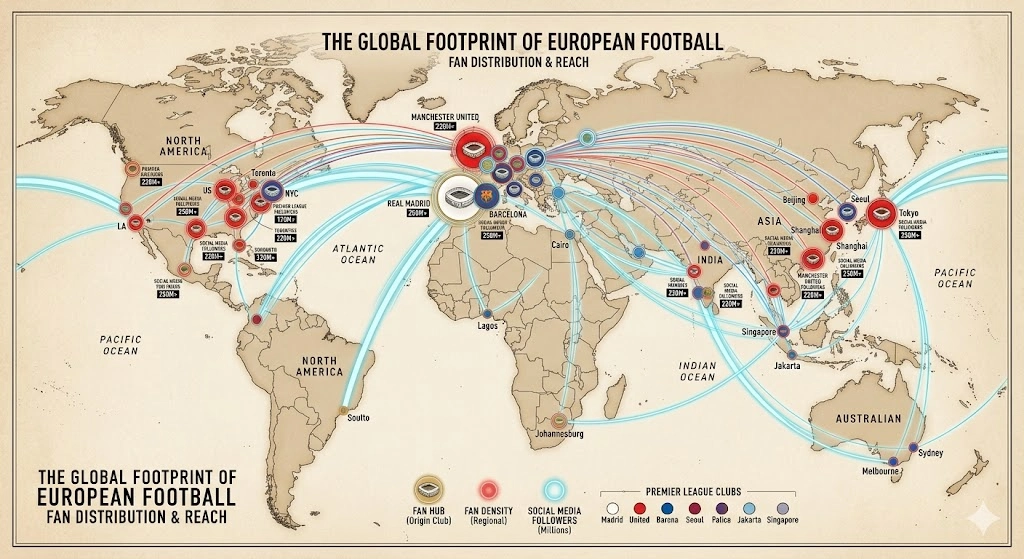
Digital platforms have become the primary engine for global fan base growth. As of June 2025, the social media rankings reveal staggering numbers:
- Real Madrid: 470+ million followers across X, Instagram, Facebook, TikTok, and YouTube
- Barcelona: 424 million followers
- Manchester United: 234 million followers
- Paris Saint-Germain: 199 million followers
These numbers represent more than just vanity metrics. “Facebook likes is almost as important a measure as match attendance” in today’s football landscape.
Multilingual Content Strategy
Clubs are no longer posting content in just English or their native language. Liverpool FC has launched seven social media profiles in different languages including Spanish and Bengential, alongside their global account.
Liverpool’s strategy goes beyond simple translation—it’s “cultural adaptation.” The club creates WhatsApp channels in Spanish and Portuguese, TikTok videos tailored to Gen Z humour, and ensures their message resonates across both languages and platforms.
As Liverpool’s digital strategy team explains: “Their multilingual strategy isn’t just translation—it’s cultural adaptation. From WhatsApp channels in Spanish and Portuguese to TikTok videos tailored to Gen Z humour, the club knows how to adapt its voice”.
This approach creates what Liverpool calls the “Global Red Family”—a close-knit global community where “language is not a barrier to engagement and targeted campaigns resonate with different segments of fans”.
Platform-Native Storytelling
The most successful clubs understand that each platform requires different content strategies. Liverpool’s approach “goes beyond likes and shares—it’s about building a fan ecosystem rooted in emotion, inclusivity, and cultural fluency”.
Clubs consistently offer free digital assets like mobile phone wallpapers and match highlights to bring fans closer to the action. By posting multilingual content, behind-the-scenes footage, and interactive campaigns, clubs ensure fans feel connected regardless of location.
Pre-Season Tours as Commercial Powerhouses
TheTour Revolution
Pre-season tours have transformed from simple warm-up exercises into strategic commercial plays that are “changing the business of football”. For Europe’s biggest clubs, these tours are now core revenue drivers that directly impact transfer budgets and long-term brand growth.
Clubs like Manchester United, Manchester City, and PSG are pocketing upwards of £10–15 million per tour through appearance fees, sponsorships, ticket sales, and merchandise.
Asia and North America: The Most Lucrative Markets
Tours in Asia and North America are especially lucrative, with specific examples demonstrating the financial impact:
- Tottenham’s visits to South Korea: Sell out stadiums completely
- PSG’s 2023 Japan tour: Generated nearly $700,000 in merchandise sales
- El Clásico in Texas: Drew over 80,000 fans to watch Real Madrid vs Barcelona
“These aren’t friendlies—they’re global branding & marketing endeavours”.
Recent Tour Examples
Barcelona’s Asian Strategy: After three successive seasons in the US, Barcelona signed a contract to play four friendlies in Asia for summer 2025, with fixtures in Japan and South Korea. Despite initial controversy including a payment issue that nearly cancelled the Japan leg, “the overall outcome has been viewed positively” with strong stadium attendance.
The Japanese and South Korean leg “has been a major success, reinforcing the club’s image and coinciding with the strong sporting performance delivered by Hansi Flick and his team”.
Manchester United and AC Milan: Both clubs confirmed pre-season schedules in Singapore and Malaysia for summer 2025, demonstrating the continued pull of Southeast Asian markets.
Liverpool’s 2025 Asia Tour: Liverpool is likely to face Spanish giants in Asia in 2025, continuing their strategy of connecting with Asian fans.
Behind-the-Scenes Logistics
The logistics behind these tours are intense:
- Multi-city travel immediately after the season ends
- Tight turnarounds before international duty
- Custom sponsorship activations and regional partnerships
- Coordination with local broadcasters and media
The gains are clear: expanding fanbases, signing new sponsors, boosting global visibility. However, risks include player fatigue, injury risk, and disrupted pre-season preparation.
Star Player Signings as Market Entry Strategies
The Global Player Effect
Signing high-profile players from different regions “enhances a club’s appeal in those markets”. This strategy has become increasingly sophisticated, with clubs targeting players who represent specific geographic markets.
Real Madrid has seen “a significant boost overseas since the arrival of Kylian Mbappé,” demonstrating how star players directly impact international merchandising growth.
Regional Player Impact
When clubs sign players from specific regions, they unlock those markets:
- South American players: Open up Brazil, Argentina, and wider Latin America
- Asian players: Unlock Japan, South Korea, China, and Southeast Asia
- African players: Connect with Nigeria, Ghana, France’s African diaspora, and wider Africa
- North American players: Strengthen US and Canadian market presence
This strategy explains why clubs are increasingly scouting globally rather than focusing on traditional European markets.
Historical Examples
Franz Beckenbauer once described football as “the world’s best means of communication. Young or old, players or fans, rich or poor, the game transcends all boundaries”. Star players embody this transcendent quality, becoming cultural ambassadors who connect clubs with new fan bases.
The Premier League’s significant viewership in regions like Australia and India is “particularly noted by clubs like Nottingham Forest” through their social media engagement, often driven by players from those regions.
Official Supporters’ Clubs: Building Community Infrastructure
Global Network Expansion
Establishing official supporters’ clubs worldwide “helps solidify fan loyalty” by allowing international fans to participate in club events, organize watch parties, and connect with fellow supporters in their region.
The scale of these networks is impressive:
- Manchester City: Over 400 official supporters club branches worldwide
- Liverpool: Over 300 official supporters clubs in more than 90 countries
These organizations transform isolated international fans into connected communities, creating local hubs where supporters can gather and celebrate their club together.
Digital Supporter Platforms
Clubs are now launching dedicated digital platforms for their global supporters. Chelsea recently launched a Supporters Club Website, described as “a major step forward in bringing fans closer to the heart of the club”.
This platform represents “a major step forward for their global network of official supporters clubs,” enabling better communication and community building.
Benefits for International Fans
Official supporters clubs provide:
- Local watch parties for matches
- Club event participation including player visits
- Community connection with fellow supporters
- Exclusive merchandise and discounts
- Travel opportunities to matchdays in Europe
- Youth academies and grassroots programs
These benefits transform passive viewers into active community members, deepening loyalty and increasing engagement.
Winning on the Pitch: The Foundation of Global Success
Trophy Success Drives International Recognition
“Winning major trophies and competing in prestigious tournaments like the UEFA Champions League and FIFA Club World Cup significantly boost a club’s international recognition”. Sporting success remains the fundamental driver of global fan base growth.
Research analyzing seven seasons (2005/2006–2011/2012) found that “public attention to foreign football clubs has indeed increased over time,” particularly driven by:
- (a) The success of a club in European and national competitions
- (b) The success of domestic players in expatriate clubs
- (c) The number of matches against domestic clubs in European competitions
The Champions League Effect
Securing international TV rights for Champions League games ensures fans worldwide can watch their favorite teams play live. The European Club Association and UEFA are targeting €5 billion for Champions League, Europa League, and Conference League media rights from 2027-2033.
For the first time, UEFA is offering a global rights package, with the chosen platform receiving priority selection for Tuesday matches to broadcast in all markets. This global accessibility means fans in previously underserved markets can now watch Europe’s best competition live.
Historical Dominance Creates Long-Term Fans
Clubs with sustained success build generational fan bases. Real Madrid’s continued dominance in the Champions League, Barcelona’s historic La Liga success, and Manchester United’s Premier League legacy have created loyal followers who remain devoted across decades, regardless of temporary setbacks.
This explains why Real Madrid, Barcelona, and Manchester United are “the three teams with the most global appeal from fans outside their own countries” according to The Global Fan Report.
Community Engagement and CSR Initiatives
Building Goodwill Through Social Responsibility
Football clubs often launch social responsibility programs—including grassroots football academies, charity projects, and educational initiatives—to connect with fans on a deeper level. These efforts help build goodwill and reinforce a club’s values and identity.
CSR (Corporate Social Responsibility) initiatives demonstrate that clubs care about communities beyond profit, creating authentic connections with international fans who value ethical business practices.
Grassroots Academies Worldwide
Establishing grassroots football academies in international markets serves multiple purposes:
- Develops local talent with club training methodologies
- Creates youth fan bases who grow up supporting the club
- Generates positive media coverage in local markets
- Builds long-term relationships with local communities
- Potentially identifies future players for the club
These academies represent investment in the future, showing clubs are committed to developing football in new markets rather than just extracting value.
Charity and Educational Programs
Charity projects and educational initiatives help clubs connect with fans emotionally. When clubs support local causes, fund scholarships, or provide educational resources, they demonstrate values that resonate with communities worldwide.
This approach aligns with modern consumer expectations, where fans increasingly support brands that demonstrate social responsibility and ethical practices.
The Technology and Infrastructure Enablers
Streaming Revolution
Securing international TV rights and digital streaming services ensures fans worldwide can watch live matches. The streaming revolution has fundamentally changed accessibility:
- 900 million homes can now watch Premier League football globally
- BBC Match of the Day reaches 59% of total UK TV viewers
- 35.7 million individuals watched live matches and highlights in one season
US Viewership Growth
NBC averages 510,000 viewers per game in the US, remaining above 500k for four consecutive seasons despite a 7% decrease in 2024-25. This demonstrates sustained American interest in European football.
Mobile-First Engagement
With fans increasingly accessing content through mobile devices, clubs prioritize mobile-optimized experiences, including:
- Mobile wallpaper downloads
- Short-form video content for TikTok and Instagram
- Mobile app experiences with live statistics
- WhatsApp channels for direct communication
This mobile-first approach ensures clubs connect with fans where they spend most of their time.
FAQ Section
Frequently Asked Questions About European Football’s Global Expansion
1. Which European football club has the largest global fan base?
Real Madrid boasts the highest number of international fans worldwide, with 15.68% of their fans residing outside Spain—the highest percentage among all clubs. They also lead all clubs with 470+ million social media followers across platforms as of June 2025.
2. How much money do pre-season tours generate for European clubs?
Top clubs like Manchester United, Manchester City, and PSG earn £10–15 million per pre-season tour through appearance fees, sponsorships, ticket sales, and merchandise. PSG’s 2023 Japan tour alone generated nearly $700,000 in merchandise sales.
3. Why are European clubs focusing so heavily on Asia and North America?
Asia and North America are the most lucrative markets for fan expansion. Tottenham’s visits to South Korea sell out stadiums, and El Clásico in Texas drew over 80,000 fans. The Premier League reaches significant viewership in Australia and India specifically.
4. How many official supporters clubs do major European clubs have worldwide?
Manchester City has over 400 official supporters club branches worldwide. Liverpool maintains over 300 official supporters clubs in more than 90 countries. These networks transform isolated international fans into connected communities.
5. What percentage of Real Madrid and Barcelona fans are international?
According to The Global Fan Report:
- Real Madrid: 15.68% of fans are abroad
- Barcelona: 10.4% of fans are abroad
- Manchester United: 9.79% of fans are abroad
Real Madrid, Barcelona, and Manchester United are the three teams with the most global appeal from fans outside their own countries.
6. How do European clubs engage with fans in different languages?
Clubs like Liverpool have launched seven social media profiles in different languages including Spanish and Bengali. They create WhatsApp channels in Spanish and Portuguese, and tailor TikTok content to different cultural contexts—this is “cultural adaptation,” not just translation.
7. What is the Premier League’s global viewership?
The Premier League is broadcast to 900 million homes across 190 countries, with 1.87 billion people following the league worldwide. In the 2022/23 season, it reached 3.23 billion total audience with 2.01 billion viewers watching live broadcasts.
Conclusion
European football clubs are expanding their global fan bases because the business of football has fundamentally transformed. What was once a locally-focused sport has become a global superindustry where commercial revenue dominates, digital engagement drives growth, and international markets determine success.
The key strategies driving this expansion are clear:
Digital Dominance: Real Madrid’s 470 million social media followers and Liverpool’s multilingual content strategy demonstrate that digital platforms are the primary engine for global growth.
Commercial Thunder: With €12.4 billion in total revenue for Europe’s richest clubs and Real Madrid generating €594 million from commercial income alone, global fan bases are now essential for financial sustainability.
Pre-Season Tours as Revenue Drivers: The £10–15 million per tour revenue from Asian and North American tours has transformed friendlies into core commercial operations.
Sporting Success as Foundation: Winning trophies and competing in the Champions League remains the fundamental driver of international recognition, with research proving success directly correlates with global attention.
Community Infrastructure: Over 400 Manchester City supporters clubs and 300 Liverpool supporters clubs worldwide create the local communities that sustain international fan loyalty.
The future of European football depends on continuing this global expansion. As domestic broadcast revenues plateau and competition intensifies, clubs must look overseas to sustain growth. The clubs that master global fan base building—balancing local identity with international ambition—will dominate football’s next era.
For fans worldwide, this expansion means closer connections to Europe’s biggest clubs, more accessible content, and the opportunity to belong to global communities united by passion for the game. Whether you’re watching from London, New York, Sydney, or São Pedro do Sul, you’re part of football’s remarkable global revolution.

My name is Jeferson, a passionate football enthusiast and the creator of this portal dedicated to fans of the world’s most popular sport. My goal is to provide reliable information, up-to-date news, match analysis, transfer updates, tournament coverage, and everything happening both on and off the pitch.