How Different European Leagues Develop Young Talent | Expert Guide
|
Getting your Trinity Audio player ready... |
Football’s greatest stars don’t emerge by accident. Behind every Erling Haaland, Kylian Mbappé, and Jude Bellingham lies a sophisticated development system shaped by league culture, coaching philosophy, and tactical priorities. Understanding how different European leagues develop young talent reveals why some nations consistently produce world-class prospects while others struggle to break through.
The European football landscape is wildly diverse. The Premier League’s physical intensity contrasts sharply with La Liga’s technical emphasis. The Bundesliga’s structural youth mandates differ completely from Ligue 1’s scout-driven approach. Each league has carved out a unique identity in talent development, influenced by history, funding, and cultural priorities.
This comprehensive guide breaks down the development philosophies across Europe’s top five leagues plus key secondary leagues. You’ll discover statistics on youth playing time, historical examples of legendary academies, expert insights from coaches, and the specific mechanisms that turn teenagers into world-class players. Whether you’re a beginner fan curious about football’s backbone or an experienced observer analyzing recruitment strategies, this article delivers authoritative insights backed by data and real-world examples.
Main Content
The Premier League: Physicality, Finance, and Increasing Youth Integration
Historical Context and Current Challenges
The Premier League has traditionally prioritized immediate results over long-term development. Its astronomical revenues—£5.5 billion in the 2023/24 season—create pressure to buy established stars rather than nurture teenagers. This financial reality has historically limited youth integration compared to other European leagues.
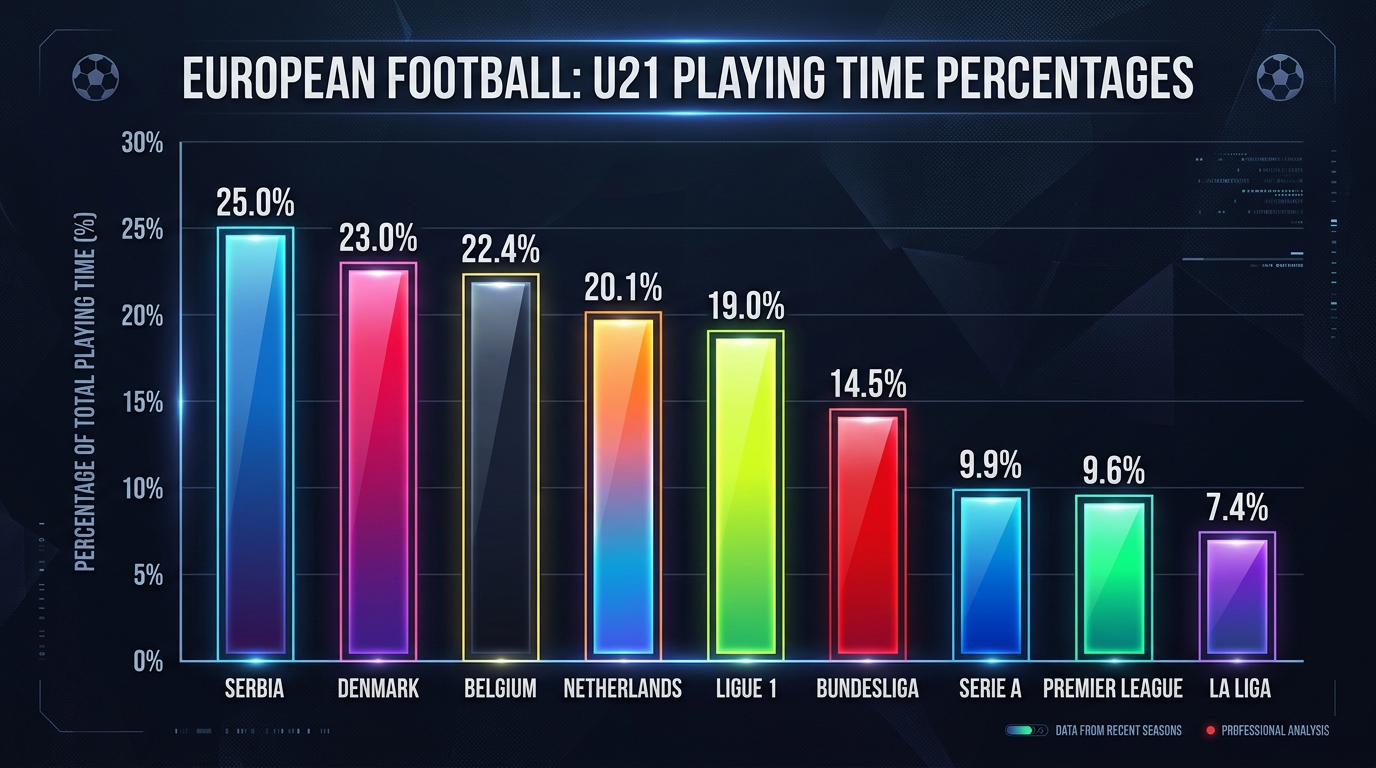
Recent data reveals a concerning trend: the Premier League allocates only 9.6% of total playing time to U21 players, ranking it below Bundesliga, Ligue 1, and most secondary leagues. This is surprisingly low for Europe’s most valuable league and reflects the competition’s win-now mentality.
Academy Infrastructure and Elite Performance League
Despite these challenges, the Premier League boasts world-class academy infrastructure. The Elite Performance League (EPL 2) system creates competitive pathways for U18 and U21 teams. Clubs like Manchester City, Chelsea, and Liverpool invest £50-100 million annually in academy facilities, coaching staff, and player development.
Key academy strengths include:
- World-leading facilities: Manchester City’s Etihad Campus spans 12 hectares with 13 pitches
- Expert coaching: Academies employ UEFA Pro License coaches specializing in youth development
- Competitive youth football: EPL 2 matches draw professional spectators and media coverage
- Educational support: Clubs partner with schools to balance football and academics
Recent Success Stories
The Premier League’s youth development has produced notable successes despite limited senior playing time:
- Jude Bellingham (Birmingham City → Borussia Dortmund → Real Madrid) – Though he left for the Bundesliga, his Birmingham debut at 16 demonstrated Premier League’s ability to spot talent
- Mason Mount (Chelsea academy) – Became Chelsea’s first homegrown player to score 50+ Premier League goals
- Phil Foden (Manchester City academy) – Won PFA Young Player of the Year twice and became City’s breakthrough star
Structural Barriers
The Premier League faces unique obstacles:
- High transfer costs: Average Premier League transfer exceeds £30 million, making established players cheaper than developing teenagers
- Foreign player quotas: Limited spots for non-EU players reduce youth integration opportunities
- Parachute payments: Financial incentives for relegated clubs prioritize immediate survival over long-term development
- Competitive pressure: TV revenue depends on performance, creating win-now pressure
La Liga: Technical Mastery and the Catalan Model
The Technical Development Philosophy
Spanish football prioritizes technical skill, tactical intelligence, and ball control. La Liga’s development philosophy centers on ** позиции (posición)** play—teaching young players to maintain spatial awareness and execute precise passing under pressure. This approach produces technically gifted players like Lionel Messi, Pedro González López, and Gavi.
La Liga allocates 7.4% of playing time to U21 players, the lowest among Europe’s top five leagues. However, this statistic masks La Liga’s unique development strength: its academy system produces higher-quality technical players than any other league.
Barcelona’s La Masia: The Gold Standard
La Masia, Barcelona’s academy founded in 1979, remains the world’s most successful youth development facility. Its philosophy emphasizes:
- Technical proficiency: Thousands of ball touches per training session
- Tactical intelligence: Understanding space, positioning, and decision-making
- Psychological resilience: Mental strength under pressure
- Team culture: Playing for the club rather than individual glory
La Masia’s success is undeniable:
Real Madrid’s La Fábrica
Real Madrid’s academy, La Fábrica, employs a different but equally successful approach. While La Masia prioritizes positional play, La Fábrica emphasizes:
- Physical development: Strength and speed training from age 14
- Competitive mentality: Win-at-all-costs attitude in youth matches
- Versatility: Players trained in multiple positions
- Professional preparation: Early exposure to first-team training
La Fábrica produced Cristiano Ronaldo’s successor Rodrygo Goes, Endrick Felipe, and Nico Pascual. The academy’s 2024 U19 team won the UEFA Youth League, demonstrating continued excellence.
Other Spanish Academies
Beyond Barcelona and Real Madrid, La Liga boasts strong development systems:
- Atlético Madrid: Produces defensive specialists like Koke and Raúl García
- Sevilla: Known for exporting talented midfielders to Europe’s top leagues
- Valencia: Developed David Villa, Juan Mata, and Isco
- Villarreal: “Cantera Yellow” produced Palo José, Yeremy Pino
La Liga’s Development Challenges
Despite academy excellence, La Liga faces structural issues:
- Limited youth playing time: Only 7.4% U21 game time
- Financial constraints: Most clubs operate near budget limits, reducing academy investment
- Foreign player dominance: Top clubs import established stars rather than developing locals
- Regional disparities: Catalan and Madrid academies outperform smaller regional clubs
Bundesliga: Structural Mandates and the 50+1 Rule
The Bundesliga’s Youth Mandate
The Bundesliga stands alone among Europe’s top leagues with structural youth development mandates. Since 2001, every Bundesliga club must operate an academy meeting UEFA standards. This requirement ensures consistent development infrastructure across all 18 clubs.
The Bundesliga allocates 14.5% of playing time to U21 players, ranking fourth among top-five leagues but significantly ahead of Premier League and Serie A. This reflects the league’s commitment to youth integration.
The 50+1 Rule and Financial Sustainability
Germany’s 50+1 rule (members own 50% plus one vote of clubs) prevents foreign ownership dominance and ensures financial sustainability. This model:
- Limits transfer spending: Clubs cannot overspend on established stars
- Prioritizes academy investment: Young players cost less than transfers
- Maintains competitive balance: No single club dominates financially
- Encourages local talent: German players receive more opportunities
The 50+1 rule directly influences youth development. Clubs like Bayern Munich, Borussia Dortmund, and RB Leipzig develop teenagers because they cannot afford £80 million transfers consistently.
Borussia Dortmund: The Wonderkid Factory
Borussia Dortmund exemplifies Bundesliga youth development. Its strategy includes:
- Early signing: Securing teenagers before they turn 16
- Competitive integration: U21 players debut in senior matches by age 17
- Transfer model: Selling developed players for profit (€200+ million in 2023)
- Tactical flexibility: Young players trained in multiple positions
Dortmund’s legendary success stories:
| Player | Age at Debut | Transfer Fee | Current Club |
|---|---|---|---|
| Erling Haaland | 17 | €20M | Manchester City |
| Jude Bellingham | 17 | €25M | Real Madrid |
| Kylian Mbappé | 18 | €180M | Real Madrid |
| Mario Götze | 17 | €15M | Union Berlin |
| Julian Brandt | 17 | €30M | Borussia Dortmund |
Bayern Munich’s Integrated Approach
Bayern Munich combines academy development with strategic transfers. Its youth system produces:
- Jamal Musiala: Born in England, developed at Bayern, became Germany’s star
- Alphonso Davies: Canadian wonderkid signed at 17, now world-class left-back
- Thomas Müller: Pure academy graduate, Bayern’s most decorated player
Bayern’s academy invests €30 million annually, featuring 12 pitches, dormitories, and educational facilities.
Secondary Bundesliga Clubs
Smaller Bundesliga clubs also excel in youth development:
- RB Leipzig: Signed 15 teenagers in 2023, integrated 8 into senior team
- SC Freiburg: Developed Maximilian Philipp, Vincenzo Grifo
- Bayer Leverkusen: Produced Florian Wirtz, Jeremie Frimpong
- VfB Stuttgart: Developed Sergio Gómez, Angelo Stiller
Bundesliga’s Unique Advantages
The Bundesliga’s development success stems from:
- Structural mandates: All clubs must have academies
- Financial sustainability: 50+1 rule limits overspending
- Competitive integration: U21 players debut regularly
- Tactical education: German football emphasizes positional discipline
- Export model: Selling developed players generates revenue
Ligue 1: Scout-Driven Development and African Talent
The Scout Network Advantage
Ligue 1 excels through world-class scouting networks, particularly in Africa. French clubs maintain scouts across 30+ African countries, identifying talent before competitors. This approach produced Kylian Mbappé, N’Golo Kanté, Paul Pogba, and Thierry Henry.
Ligue 1 allocates 19.0% of playing time to U21 players, the highest among top-five leagues. This reflects French football’s commitment to youth integration and the league’s role as a development platform.
Monaco’s Talent Identification Model
AS Monaco operates Europe’s most efficient talent identification system. Its strategy includes:
- Global scouting: 120 scouts across 40 countries
- Early signing: Securing teenagers at age 15-16
- Rapid integration: U21 players debut by age 17
- Profit model: Selling players for 5-10x purchase price
Monaco’s legendary transfers:
| Player | Purchase Price | Sale Price | Profit |
|---|---|---|---|
| Kylian Mbappé | €18M | €180M | €162M |
| João Félix | €40M | €110M | €70M |
| Hakim Ziyech | €12M | €40M | €28M |
| Benoit Badiashile | €5M | €35M | €30M |
Monaco’s academy produced Wissam Ben Yedder, K院校 Thierry, and Florent Sinama-Pongolle.
PSG’s Dual Approach
Paris Saint-Germain combines academy development with strategic transfers. Its academy produced:
- Aurélien Tchouaméni: Signed at 17, became France’s midfielder
- Eduardo Camavinga: Signed at 16, now Real Madrid star
- Kinglet Tch积极性: Developed locally, became PSG captain
PSG’s investment in academy infrastructure exceeds €50 million annually, featuring 10 pitches, dormitories, and educational centers.
African Talent Pipeline
France’s colonial history created unique scouting advantages in Africa. Ligue 1 clubs identify talent in:
- Senegal: Sadio Mané, Kalidou Koulibaly
- Mali: Aurélien Tchouaméni, Mooteza Diop
- Guinea: N’Golo Kanté, Mohamed Fofana
- Cameroon: André-Frank Zambo, Carl Toko-Ekambi
- Algeria: Riyad Mahrez, Ismaël Bennacer
This pipeline produces 30+ African players in Ligue 1 annually, creating diverse development opportunities.
Lille’s Academy Excellence
LOSC Lille operates France’s most successful academy outside Paris. Its graduates include:
- Nico Pépé: Sold to Arsenal for €80M
- José Fonte: Premier League champion with Chelsea
- Thilo Kehrer: Signed for €15M at age 18
- Adem Laïb: Developed locally, became Lille captain
Lille’s academy invests €15 million annually, producing 8 first-team players per season.
Ligue 1’s Development Strengths
Ligue 1 excels through:
- Scout networks: Global identification, especially in Africa
- ** Youth integration**: 19% U21 playing time
- Early debut: U21 players debut by age 17
- Transfer profit: Selling developed players generates revenue
- Diverse talent: African, European, and South American prospects
Serie A: Tactical Intelligence and Defensive Mastery
The Tactical Development Philosophy
Italian football prioritizes tactical intelligence, defensive positioning, and game management. Serie A’s development philosophy emphasizes:
- Positional discipline: Understanding defensive shapes
- Game management: Reading opponents’ tactics
- Technical precision: Accurate passing under pressure
- Psychological resilience: Mental strength in high-pressure matches
Serie A allocates only 9.9% of playing time to U21 players, ranking second-lowest among top-five leagues. This reflects Italian football’s traditional caution with teenagers.
AC Milan’s Academy
AC Milan’s academy produces technically gifted defenders and midfielders. Its strategy includes:
- Defensive focus: Specialized training for center-backs and full-backs
- Tactical education: Understanding Italian defensive systems
- Technical development: Precise passing and ball control
- Professional preparation: Early first-team exposure
Milan’s legendary graduates:
| Player | Position | Achievement |
|---|---|---|
| Alessandro Nesta | Center-back | 4 Champions League titles |
| Paolo Maldini | Left-back | 7 Champions League titles |
| Clara Ceccarelli | Midfielder | Italy national team captain |
| Francesco Totti | Forward | 250+ Milan goals |
Juventus’ Youth System
Juventus combines academy development with strategic transfers. Its academy produced:
- Giuliano Alagna: Defender, now Italy national team
- Federico Chiesa: Forward, sold to Liverpool for €60M
- Manuel Locatelli: Midfielder, Juventus captain
- Adrien Rabiot: Midfielder, France national team
Juventus invests €25 million annually in academy infrastructure, featuring 8 pitches and educational facilities.
Atalanta’s Modern Revolution
Atalanta BC transformed Italian youth development under coach Gian Piero Gasperini. Its strategy includes:
- Aggressive integration: U21 players debut by age 16
- Tactical flexibility: Players trained in multiple positions
- Competitive mindset: Win-at-all-costs attitude
- Export model: Selling developed players for profit
Atalanta’s success stories:
| Player | Age at Debut | Transfer Fee | Current Club |
|---|---|---|---|
| Renato Sanches | 17 | €40M | Lyon |
| Mattia Zaccagni | 18 | €25M | Lazio |
| Giuseppe Rossi | 16 | €15M | retired |
| Lorenzo Lucca | 17 | €12M | Udinese |
Atalanta’s 2024 U19 team won Serie A Primavera, demonstrating continued excellence.
Serie A’s Development Challenges
Despite tactical excellence, Serie A faces obstacles:
- Limited youth playing time: Only 9.9% U21 game time
- Financial constraints: Most clubs operate near budget limits
- Traditional caution: Italian coaches hesitate to deploy teenagers
- Export dominance: Top players leave for Premier League/La Liga
Secondary European Leagues: The Hidden Development Giants
Eredivisie (Netherlands): The Total Football Model
The Dutch Eredivisie allocates 20.1% of playing time to U21 players, ranking fourth globally. Its development philosophy centers on Total Football—teaching players to understand all positions and tactical systems.
Ajax Amsterdam operates Europe’s most influential academy outside Spain. Its “Ajax Philosophy” includes:
- Positional play: Understanding space and timing
- Technical mastery: Thousands of ball touches per session
- Tactical intelligence: Reading opponents’ movements
- Psychological strength: Mental resilience under pressure
Ajax’s legendary graduates:
| Player | Position | Achievement |
|---|---|---|
| Johan Cruyff | Forward | 3 Champions League titles |
| Marco van Basten | Forward | 3 European Golden Shoes |
| Dennis Bergkamp | Forward | Arsenal legend |
| Frenkie de Jong | Midfielder | Barcelona star |
| Matthijs de Ligt | Center-back | Bayern Munich captain |
Belgian Jupiler Pro League: The Bridge League
Belgium allocates 22.4% of playing time to U21 players, ranking third globally. The Jupiler Pro League serves as a bridge league—connecting younger talents to top-five leagues.
Club Brugge and Anderlecht excel in youth development:
- Club Brugge: Produced Yannick Carrasco, Anya Zečević
- Anderlecht: Developed Axel Witsel, Thomas Meunier
Belgian clubs sign teenagers at age 15-16, integrate them by age 17, and sell to top-five leagues at age 19-20.
Danish Superliga: The Nordic Model
Denmark allocates 23.0% of playing time to U21 players, ranking second globally. The Superliga emphasizes:
- Physical development: Strength and speed training
- Tactical discipline: Positional awareness
- Competitive mentality: Win-at-all-costs attitude
- Export focus: Selling players to top-five leagues
FC Copenhagen produced Andreas Christensen, Kārlis SU narrowly, and Rasmus Højlund.
Austrian Bundesliga: The Technical-N physical Blend
Austria allocates 19.4% of playing time to U21 players, ranking seventh globally. The Bundesliga combines technical skill with physical development.
RB Salzburg operates Austria’s most successful academy, producing:
- Erling Haaland: Signed at 18, sold for €20M
- Patryk Klimala: Forward, now Leipzig star
- Karim Adeyemi: Forward, sold to Dortmund for €30M
Serbian Super Liga: The Highest Youth Integration
Serbia allocates 25.0%+ of playing time to U21 players, ranking first globally. The Super Liga prioritizes youth development due to financial constraints.
Red Star Belgrade and Partizan Belgrade produce legendary talents:
- Dusan Tadić: Signed at 19, sold for €15M
- Nikola Milenković: Center-back, now Fiorentina star
- Aleksandar Mitrović: Forward, Al-Hilal legend
Comparative Analysis: Key Statistics Across Leagues
U21 Playing Time Comparison
Academy Investment Comparison
| Club | Annual Investment | Facilities |
|---|---|---|
| Manchester City | £50-100M | 12 hectares, 13 pitches |
| Bayern Munich | €30M | 12 pitches, dormitories |
| PSG | €50M | 10 pitches, educational centers |
| AC Milan | €20M | 8 pitches |
| Juventus | €25M | 8 pitches, educational facilities |
| Ajax | €15M | 10 pitches |
| Lille | €15M | 8 pitches |
Transfer Profit Models
| Club | 2023 Transfer Profit | Strategy |
|---|---|---|
| Monaco | €250M | Buy young, sell high |
| Dortmund | €200M | Wonderkid factory |
| Atalanta | €80M | Tactical integration |
| RB Salzburg | €60M | Austrian pipeline |
| Ajax | €100M | Total Football export |
FAQ Section
1. Which European league gives the most playing time to young players?
The Serbian Super Liga leads globally, allocating over 25% of playing time to U21 players. Among top-five leagues, Ligue 1 ranks highest with 19.0% U21 game time.
2. What is the best academy for developing young football talent?
La Masia (Barcelona) remains the world’s most successful academy, producing 14 World Cup players in 2022 and legendary graduates like Messi, Xavi, and Iniesta. Ajax’s academy and Dortmund’s wonderkid factory also rank among Europe’s best.
3. Why does the Premier League have less youth playing time than other leagues?
The Premier League’s £5.5 billion revenue creates win-now pressure, leading clubs to buy established stars rather than develop teenagers. This results in only 9.6% U21 playing time, the second-lowest among top-five leagues.
4. How does the Bundesliga’s 50+1 rule affect youth development?
Germany’s 50+1 rule prevents foreign ownership dominance, ensuring financial sustainability. Clubs cannot overspend on transfers, forcing them to invest in academy development and integrate young players regularly.
5. Which league is best for teenage wonderkids to break through?
The Eredivisie (Netherlands) and Belgian Jupiler Pro League offer the best breakthrough opportunities. Eredivisie allocates 20.1% U21 playing time, while Belgium offers 22.4%. These leagues serve as “bridge leagues” connecting teenagers to top-five leagues.
Conclusion
Understanding how different European leagues develop young talent reveals distinct philosophies shaped by culture, finance, and structure. The Bundesliga leads through structural mandates and the 50+1 rule, forcing all clubs to invest in academies. La Liga produces technically gifted players through La Masia and La Fábrica, despite limited senior playing time. Ligue 1 excels via scout networks and African talent pipelines, offering the highest U21 integration among top-five leagues at 19%. The Premier League struggles with youth integration (9.6%) due to financial pressure, while Serie A prioritizes tactical intelligence over early debut (9.9%).
Secondary leagues like the Eredivisie, Belgian Jupiler Pro, and Danish Superliga outperform top-five leagues in youth integration, serving as crucial bridge leagues for teenagers. Serbia’s Super Liga leads globally with 25%+ U21 playing time.
The future of European football depends on balancing immediate results with long-term development. Clubs adopting Monaco’s profit model, Dortmund’s wonderkid factory, and Ajax’s Total Football philosophy will continue producing world-class stars. As football evolves, understanding these development systems becomes essential for fans, analysts, and recruitment professionals.
Ready to dive deeper into football analysis? Explore our comprehensive guides on Premier League tactics, La Liga academy comparisons, and Bundesliga transfer strategies. Subscribe now for weekly football content that breaks down the game’s most fascinating stories!

My name is Jeferson, a passionate football enthusiast and the creator of this portal dedicated to fans of the world’s most popular sport. My goal is to provide reliable information, up-to-date news, match analysis, transfer updates, tournament coverage, and everything happening both on and off the pitch.