Comparing the Playing Styles of Europe’s Top Leagues | Tactical Guide
|
Getting your Trinity Audio player ready... |
Football is more than just a game—it’s a cultural language spoken differently across every continent. But within Europe itself, the gap between leagues is astonishing. The same sport can feel like a high-octane rugby match in England, a chess match in Italy, or a ballet performance in Spain. Understanding these differences isn’t just for coaches; it transforms how fans watch, analyse, and appreciate every pass, tackle, and goal.
When you compare the playing styles of Europe’s top leagues, you uncover a fascinating tapestry of tactical evolution, cultural identity, and historical tradition. Each league has carved out a distinct identity that shapes how teams build attacks, defend, and transition between phases.
In this comprehensive guide, we’ll break down the English Premier League, La Liga, Serie A, Bundesliga, and Ligue 1. You’ll discover the statistics that define them, the historical moments that shaped them, and the expert insights that explain why these divisions remain so different despite decades of globalisation. Whether you’re a casual fan or a tactics enthusiast, this article will deepen your understanding of European football’s beautiful diversity.
Main Content
The Five Major European Leagues at a Glance
Europe’s “top five” leagues dominate global football attention, revenue, and Champions League representation. These are:
- English Premier League (EPL) – England
- La Liga – Spain
- Serie A – Italy
- Bundesliga – Germany
- Ligue 1 – France
Each league attracts millions of viewers worldwide, yet they offer fundamentally different football experiences. The differences stem from coaching philosophies, player recruitment patterns, cultural attitudes toward sport, and historical tactical development.
Let’s dive deep into what makes each league unique.
English Premier League: Physicality, Pace, and End-to-End Action
The Premier League’s Signature Style
The English Premier League is widely recognised as the fastest, most physical, and most entertaining league in Europe. Its playing style prioritises high tempo, intense pressing, and quick transitions. Teams rarely sit back for long periods; instead, they push constantly for goals.
Liverpool under Jürgen Klopp and Manchester City under Pep Guardiola exemplify this philosophy. Klopp’s “gegenpressing” system demands immediate counter-pressing after losing the ball, while City dominate through explosive vertical passes and relentless attacking waves. Both approaches reflect the Premier League’s broader identity: football as a high-speed spectacle.
Key Statistical Traits
| Metric | Premier League Average |
|---|---|
| Passes per game | ~480 |
| Pass completion | ~82% |
| Shots per game | ~13.5 |
| Goals per game | ~2.8 |
| Distance covered per player | ~10.8 km |
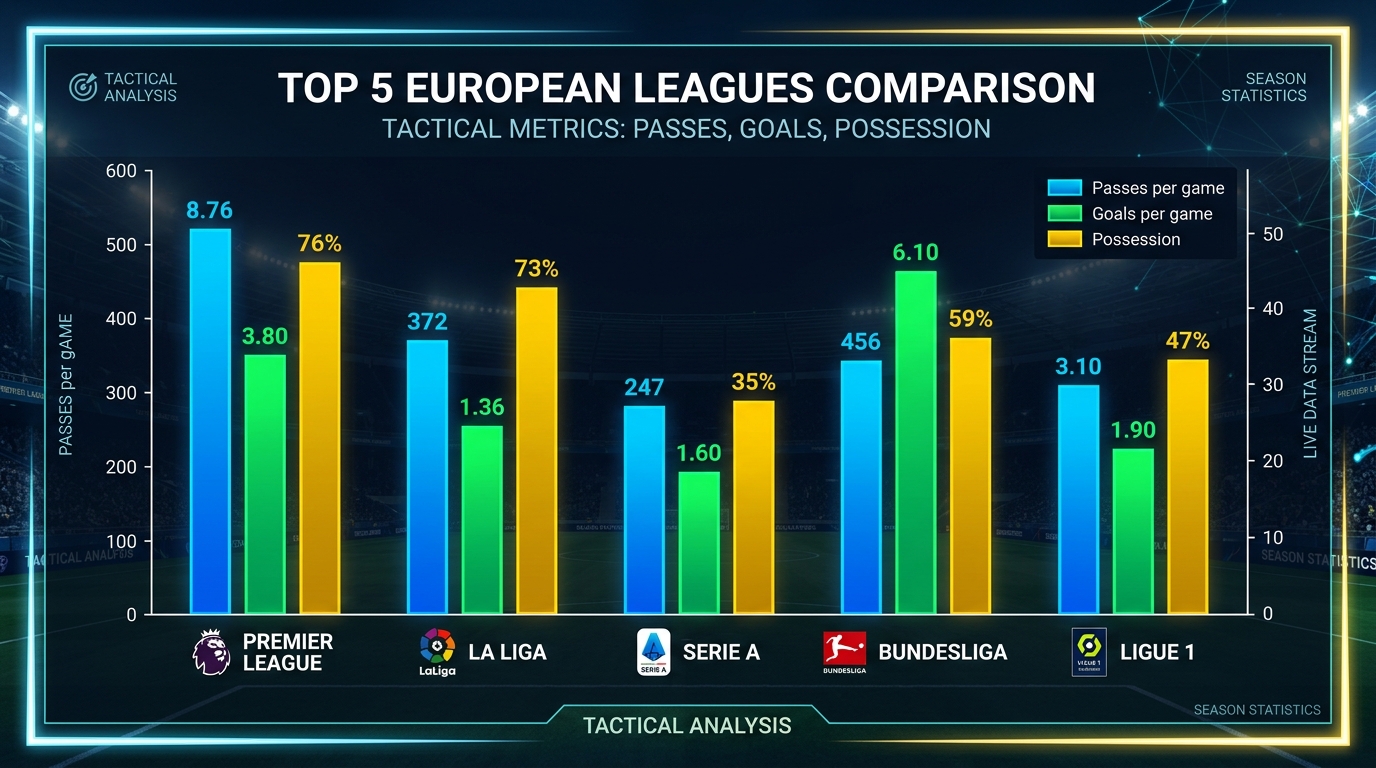
The Premier League records the highest number of shots and goals per game among Europe’s top five leagues. Matches feature fewer breaks, more duels, and greater physical intensity. Players average more tackles, sprint distances, and aerial battles than in any other division.
Why Is It So Fast?
Several factors drive the Premier League’s speed:
- Cultural preference for direct, attacking football
- Recruitment of athletic, versatile players from Africa, South America, and other European leagues
- Coaching trends favouring high pressing and transition play
- Financial power allowing clubs to buy elite pace and strength
The league’s global broadcasting reach also reinforces this style, as broadcasters and fans reward exciting, goal-filled matches.
Historical Context
The Premier League’s modern identity emerged in the 1990s after breaking from the Football League. Initially criticised for being too physical and undisciplined, the league gradually embraced technical sophistication while retaining its core intensity. The arrival of foreign coaches like Arsène Wenger, José Mourinho, and Klopp transformed English football into a hybrid of tradition and innovation.
La Liga: Possession, Control, and Technical Mastery
La Liga’s Signature Style
Spanish football is synonymous with possession, control, and technical brilliance. La Liga prioritises short passing, patient build-up play, and creative dribbling. Teams like Barcelona and Real Madrid have defined generations through their mastery of ball dominance.
Barcelona’s tiki-taka philosophy under Pep Guardiola revolutionised global football. It emphasised relentless short passes, movement off the ball, and positional flexibility. Real Madrid, meanwhile, blends possession with explosive counter-attacks, using elite individual talent to unlock defenses.
Key Statistical Traits
| Metric | La Liga Average |
|---|---|
| Passes per game | ~540 |
| Pass completion | ~85% |
| Shots per game | ~11.8 |
| Goals per game | ~2.5 |
| Possession average | ~52% |
La Liga records the highest pass completion rate and most passes per game among Europe’s top leagues. Possession dominates, but goal output is lower than the Premier League. Matches are often more tactical, with fewer reckless challenges.
Why Is It So Technical?
Spain’s football culture emphasises skill development from childhood. The La Fábrica (Real Madrid’s academy) and La Masia (Barcelona’s academy) produce technically gifted players who excel in tight spaces. Coaching philosophies across the league reinforce ball control, spatial awareness, and patience.
Historical Context
La Liga’s identity was shaped by the 2008–2012 era when Spain dominated international football with Barcelona and Real Madrid leading the Champions League. The national team’s 2008–2012 golden generation (including Euro 2008, 2010 World Cup, and Euro 2012 wins) cemented possession football as Spain’s signature. This period elevated La Liga globally as the league of technical perfection.
Serie A: Tactical Discipline, Defensive Solidity, and Strategic Football
Serie A’s Signature Style
Italian football is famous for tactical discipline, defensive organisation, and strategic cunning. Serie A prioritises structured formations, defensive solidity, and calculated attacks. Teams like Juventus and Inter Milan excel at minimising risks while exploiting opponents’ weaknesses.
The catenaccio (keyhole) system, invented in Italy, remains influential. It emphasises deep defensive lines, sweepers, and patient counter-attacking. Modern Serie A teams blend this tradition with modern pressing, but defensive intelligence remains central.
Key Statistical Traits
| Metric | Serie A Average |
|---|---|
| Passes per game | ~490 |
| Pass completion | ~83% |
| Shots per game | ~11.2 |
| Goals per game | ~2.4 |
| Tackles per game | ~17.5 |
Serie A records the lowest goals per game among Europe’s top five leagues. Matches feature more tackles, fewer shots, and greater defensive focus. The league rewards tactical intelligence over pure speed.
Why Is It So Tactical?
Italy’s football culture values strategy, patience, and defensive mastery. Coaches are seen as artists who craft intricate systems. The moderno catenaccio and retrieve-and-progress philosophies dominate modern Italian coaching.
Historical Context
Serie A’s golden era (1980s–1990s) featured legendary clubs like Juventus, AC Milan, and Inter dominating Europe. The catenaccio system defined this period. Though Serie A declined financially in the 2000s, its tactical identity persists. Recent successes by Napoli, Juventus, and Atalanta show Italy remains a tactical powerhouse.
Bundesliga: Aggression, High Pressing, and Goal-Thrilling Football
Bundesliga’s Signature Style
The German Bundesliga is fast, aggressive, and attack-focused. Teams prioritise high pressing, quick counters, and relentless attacking. Bayern Munich and Borussia Dortmund exemplify this philosophy, sacrificing defensive stability for goal-scoring opportunities.
Julian Nagelsmann’s “vertical football” and Thomas Tuchel’s pressing systems reflect the league’s emphasis on speed and intensity. The Bundesliga encourages young attackers to flourish, producing some of Europe’s most exciting forwards.
Key Statistical Traits
| Metric | Bundesliga Average |
|---|---|
| Passes per game | ~500 |
| Pass completion | ~83% |
| Shots per game | ~14.2 |
| Goals per game | ~3.0 |
| High presses per game | ~110 |
The Bundesliga records the highest goals per game in Europe’s top five leagues. Matches feature more shots, high presses, and attacking risk-taking. Defenses are often exposed, leading to thrilling end-to-end action.
Why Is It So Attacking?
Germany’s football culture values aggression, youth development, and fan engagement. The 50+1 rule ensures fan ownership, keeping clubs accountable and encouraging attacking philosophies. Coaching academies emphasise pressing, vertical passing, and fast transitions.
Historical Context
The Bundesliga’s modern identity emerged after the 2000s financial crisis, when clubs reinvented themselves through youth development and attacking football. Bayern’s dominance under Hansi Flick and Dortmund’s “young rocket” era cemented the league’s reputation as Europe’s most thrilling division.
Ligue 1: Physicality, Speed, and Emerging Talent
Ligue 1’s Signature Style
French football combines physicality with speed. Ligue 1 prioritises direct attacking, quick transitions, and intense duels. Paris Saint-Germain and Lyon exemplify this approach, using elite pace and strength to dominate matches.
The league is known for producing technically gifted, physically dominant players who excel in transition. Young talents like Kylian Mbappé (before his PSG departure) and Eduardo Camavinga showcase Ligue 1’s unique blend of speed and skill.
Key Statistical Traits
| Metric | Ligue 1 Average |
|---|---|
| Passes per game | ~470 |
| Pass completion | ~81% |
| Shots per game | ~12.5 |
| Goals per game | ~2.6 |
| Duels per game | ~145 |
Ligue 1 records the most duels per game and moderate goal output. Matches feature intense physical battles, quick transitions, and emerging talent. The league is often viewed as a stepping stone to bigger leagues.
Why Is It So Physical?
France’s football culture emphasises athleticism, speed, and versatility. Coaching philosophies blend physical training with technical development. The league recruits heavily from Africa, bringing athletic Gems who thrive in transition-heavy systems.
Historical Context
Ligue 1’s modern era began in the 2000s with PSG’s rise following Qatar Sports Investments’ acquisition. The league has transformed from a modest division into a talent factory, producing world-class players for Premier League and La Liga clubs.
Comparing the Leagues: A Tactical Breakdown
Pace and Tempo
| League | Pace Rating | Tempo Style |
|---|---|---|
| Premier League | ⭐⭐⭐⭐⭐ | Extremely fast, end-to-end |
| Bundesliga | ⭐⭐⭐⭐⭐ | Fast, aggressive |
| Ligue 1 | ⭐⭐⭐⭐ | Moderate-fast, direct |
| La Liga | ⭐⭐⭐ | Controlled, patient |
| Serie A | ⭐⭐ | Slow, tactical |
The Premier League and Bundesliga are fastest. La Liga and Serie A are slower but more controlled.
Possession vs. Directness
| League | Possession Focus | Direct Attack |
|---|---|---|
| La Liga | Highest | Low |
| Serie A | Moderate | Low |
| Premier League | Moderate | Highest |
| Bundesliga | Moderate | Highest |
| Ligue 1 | Low | High |
La Liga dominates possession. Premier League and Bundesliga favour direct attacks.
Defensive Intensity
| League | Tackles per Game | Defensive Organisation |
|---|---|---|
| Serie A | Highest | Most structured |
| Premier League | High | Aggressive |
| Bundesliga | Moderate | Less structured |
| Ligue 1 | High | Physical |
| La Liga | Low | Technical |
Serie A is most defensive. Premier League and Ligue 1 are most physical.
How Cultural Identity Shapes Playing Styles
Playing styles aren’t accidental—they reflect national culture.
- England: Fast, physical, entertaining football mirrors British culture’s love for directness and spectacle.
- Spain: Patient, technical football reflects Spanish culture’s emphasis on artistry and control.
- Italy: Tactical, defensive football mirrors Italian culture’s strategic thinking and caution.
- Germany: Aggressive, attacking football reflects German culture’s discipline and intensity.
- France: Physical, speed-based football mirrors French culture’s blend of athleticism and creativity.
Coaches interviewed in research confirm这些 styles are culturally influenced and historically developed.
The Impact of Globalisation on League Styles
Despite globalisation, league identities remain distinct. Foreign coaches, players, and tactics have blended styles, but core identities persist:
- Premier League still fastest
- La Liga still most possession-focused
- Serie A still most tactical
- Bundesliga still most attacking
- Ligue 1 still most physical
Financial power and broadcasting have increased convergence, but cultural roots prevent full homogenisation.
FAQ Section
1. What are Europe’s top five football leagues?
Europe’s top five leagues are the English Premier League, La Liga (Spain), Serie A (Italy), Bundesliga (Germany), and Ligue 1 (France). These leagues dominate global football revenue, Champions League representation, and viewer attention.
2. Which league has the highest goals per game?
The Bundesliga records the highest goals per game (~3.0), followed closely by the Premier League (~2.8). Both leagues prioritise attacking football and high pressing.
3. Which league is most possession-focused?
La Liga is the most possession-focused league, with the highest passes per game (~540) and pass completion rate (~85%). Barcelona and Real Madrid define this style.
4. Which league is most defensive?
Serie A is the most defensive league, recording the lowest goals per game (~2.4) and highest tackles per game. Italian football prioritises tactical discipline and defensive organisation.
5. Why do playing styles differ between leagues?
Playing styles differ due to cultural identity, coaching philosophies, player recruitment patterns, and historical tactical development. Research confirms these styles are culturally influenced and historically evolved.
Conclusion
Comparing the playing styles of Europe’s top leagues reveals football’s beautiful diversity. The Premier League offers explosive pace and physicality. La Liga delivers technical mastery and possession control. Serie A showcases tactical discipline and defensive intelligence. The Bundesliga provides aggressive, goal-thrilling action. Ligue 1 blends physicality with speed and emerging talent.
Each league reflects its nation’s culture, history, and football philosophy. Despite globalisation, these identities remain distinct, offering fans varied experiences. Whether you love end-to-end action, patient build-up, or tactical cunning, Europe’s top five leagues deliver something unique.
Understanding these differences transforms how you watch football. You’ll notice why a Premier League clash feels different from a La Liga masterpiece or a Serie A chess match. This knowledge deepens your appreciation for the sport’s tactical richness.

My name is Jeferson, a passionate football enthusiast and the creator of this portal dedicated to fans of the world’s most popular sport. My goal is to provide reliable information, up-to-date news, match analysis, transfer updates, tournament coverage, and everything happening both on and off the pitch.